 Post by
A leaking metal roof is almost always a problem at a joint, a fastener or a penetration, not in the middle of a panel, and the lasting fix is to reseal or replace that detail rather than cover it. Professional metal roof repair means finding the true entry point, correcting the failed seam, screw or flashing, and checking the rest of the roof for the same weakness. We repair metal roofs for homes and commercial buildings in Florida and Missouri, and this guide covers what to do in the first hour, how a proper repair is made, what it typically costs and when to bring in a licensed roofer.
TL;DR
- Most metal roof leaks start at fasteners, lap joints, flashings and roof penetrations, so the repair belongs there, not on the open panel.
- During rain, contain the water inside and stay off the roof. A wet metal surface is extremely slippery.
- A lasting repair removes the cause (failed sealant, backed-out screws, worn flashing) rather than coating over it.
- National published ranges put a typical metal roof leak repair at roughly $200 to $1,000, with corrosion damage costing more.
- A roof that is inspected and maintained regularly can serve for decades, so early repair is the cheapest repair.
Table of Contents
- Where metal roofs actually leak
- Signs your metal roof needs repair
- What to do first when it is leaking
- How a lasting metal roof repair is made
- What metal roof repair costs
- Repair, restore or replace?
- Residential and commercial metal roofs
- Keeping the next leak from happening
- Our perspective on metal roof repair
- Get your metal roof repaired by a licensed team
- FAQ
- Sources
Where metal roofs actually leak
Metal panels are large, continuous sheets of steel or aluminum, so the sheet itself rarely lets water through. According to a roof-consulting firm’s 2026 write-up, 95% or more of a metal roof is not a leak risk, and failures typically occur at joints, penetrations or areas where panel movement has been restricted. That matches what homeowners find in practice: the leak is at a detail, not across the field of the roof.
The usual suspects:
- Fasteners. On exposed-fastener roofs, each screw has a rubber washer that seals the hole. Over years of heat and cold the washer hardens and cracks, or the screw backs out as the metal expands and contracts. The Florida Division of Emergency Management’s metal roof guidance tells owners of externally fastened roofs to periodically check fasteners, replace loose ones and add fasteners where spacing is too wide, following the manufacturer’s instructions.
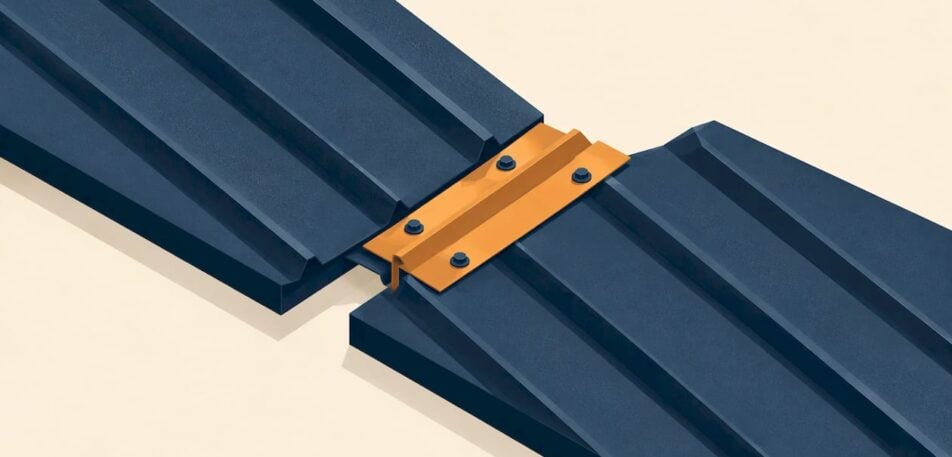
- Lap joints and seams. Where two panels overlap, sealant or butyl tape keeps water out. When it dries, shrinks or was never continuous, water can enter, and water can also creep sideways through tiny gaps between sheets, so the drip inside may be far from the opening outside.
- Penetrations. Pipe boots, vents, skylights and chimneys all interrupt the panels and all depend on flashing and sealant. These are the first places a roofer looks.
- Edges, ridge and trim. Loose ridge caps and edge covers let wind-driven rain in, which is especially relevant in hurricane and severe-storm regions.
- Corrosion and damage. Scratches that expose bare steel, standing water, debris and hail or wind damage can all open the roof surface itself.
That last point is why storms matter. After a hurricane or hail event, a roof that looked fine can have loosened fasteners, lifted trim or dented seams that only show up as a stain weeks later.
Signs your metal roof needs repair
You do not need to climb up to spot trouble. The Florida guidance suggests looking from a ladder at the roof edge for gouges, holes, rust, paint loss and loose ridge or edge covers, and checking the attic on a sunny day for daylight, stains and water near chimneys, roof-shape changes and penetrations.
Call for an inspection when you see any of these:
- Brown or yellow stains on a ceiling, or paint bubbling on a wall below the roofline
- Damp or compressed insulation in the attic, or visible daylight through the deck
- Rust streaks, flaking paint or white corrosion on panels
- Screws that are visibly raised, missing or surrounded by dark staining
- Dried, cracked or peeling sealant at seams and around vents
- Ridge caps, trim or panel edges that look lifted after a storm
- A musty smell in the attic or upper rooms
If you only have a stain, resist assuming the roof opening is directly above it. The University of Wisconsin Extension notes that leaks are rarely directly above the ceiling water spot and suggests following the drip trail in the attic to locate the real source. On metal, water also travels along the underside of the panel, so the entry point is often higher up the slope.
What to do first when it is leaking
The goal in the first hour is to limit damage, not to repair the roof.
- Contain the water inside. Move furniture and belongings, place buckets under drips and lay towels or plastic sheeting. If a ceiling is bulging with water, a small hole over a bucket relieves the pressure and prevents a larger collapse.
- Stay off the roof in rain. Wet metal panels are slippery, and a fall is a far bigger problem than a leak. Wait for dry conditions, and leave steep or high roofs to professionals.
- Look from the attic. With a flashlight, check for dripping, wet insulation or daylight around vents, chimneys and seams. Photograph what you find, with a date.
- Dry out the interior. Remove wet insulation and run fans or a dehumidifier. Prolonged moisture invites mold and can weaken framing.
- Photograph the exterior damage from the ground. This helps with an insurance claim and with the roofer’s diagnosis.
- Call a licensed roofer for the permanent repair. A temporary patch is only a bridge. Water stopped at the wrong spot can simply find another path.
If the leak followed a storm, call us promptly. Our emergency leak detection and repair is built for exactly this situation, and our guide to how roof leak detection works explains how a roofer traces the source.
How a lasting metal roof repair is made
The difference between a repair that holds and one that returns next season is whether it fixes the cause. Metal roofs move constantly with temperature, and anything that does not allow for that movement eventually fails.
Diagnose before you seal
A proper inspection works through the roof in order: panel surface, seams and fasteners, penetrations, then edges and trim. Professional inspectors also check that sealant is continuous along joints and that fasteners are tight and airtight, rather than judging by appearance alone.
Fix the fastener or seam
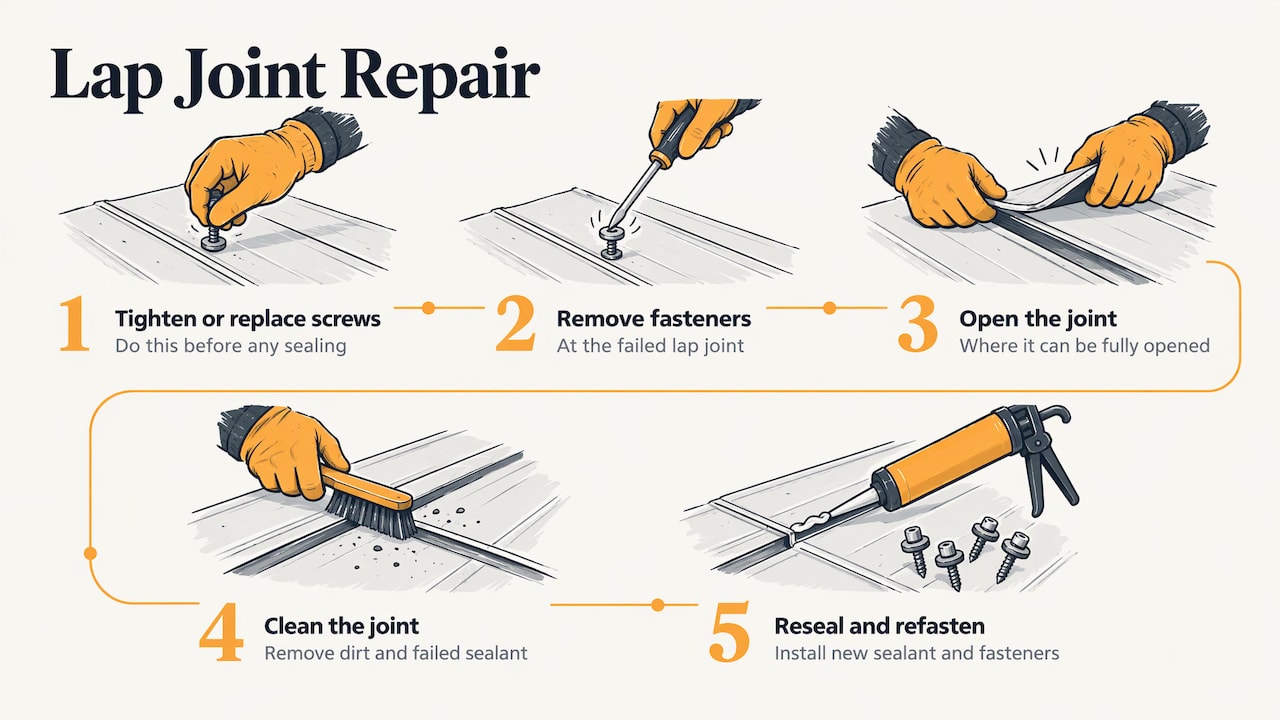
Tightening or replacing loose screws comes before any sealing. Where a lap joint has failed, the consulting firm Benchmark describes the sound method: remove the fasteners, open the joint, clean out dirt and failed sealant, reseal with new sealant and install new fasteners. When the joint cannot be fully opened, a pumpable polyurethane sealant can stand in for butyl tape. The same source states that resealing the joint is almost always less expensive and more effective than a topical repair.
That is also why a layer of coating or caulk spread over a leaking seam tends to disappoint. Benchmark notes that topical repairs applied over a failed joint don’t address the root cause and can trap moisture beneath them, and that earlier repair materials must be removed and cleaned before a new repair.
Repair flashing and penetrations
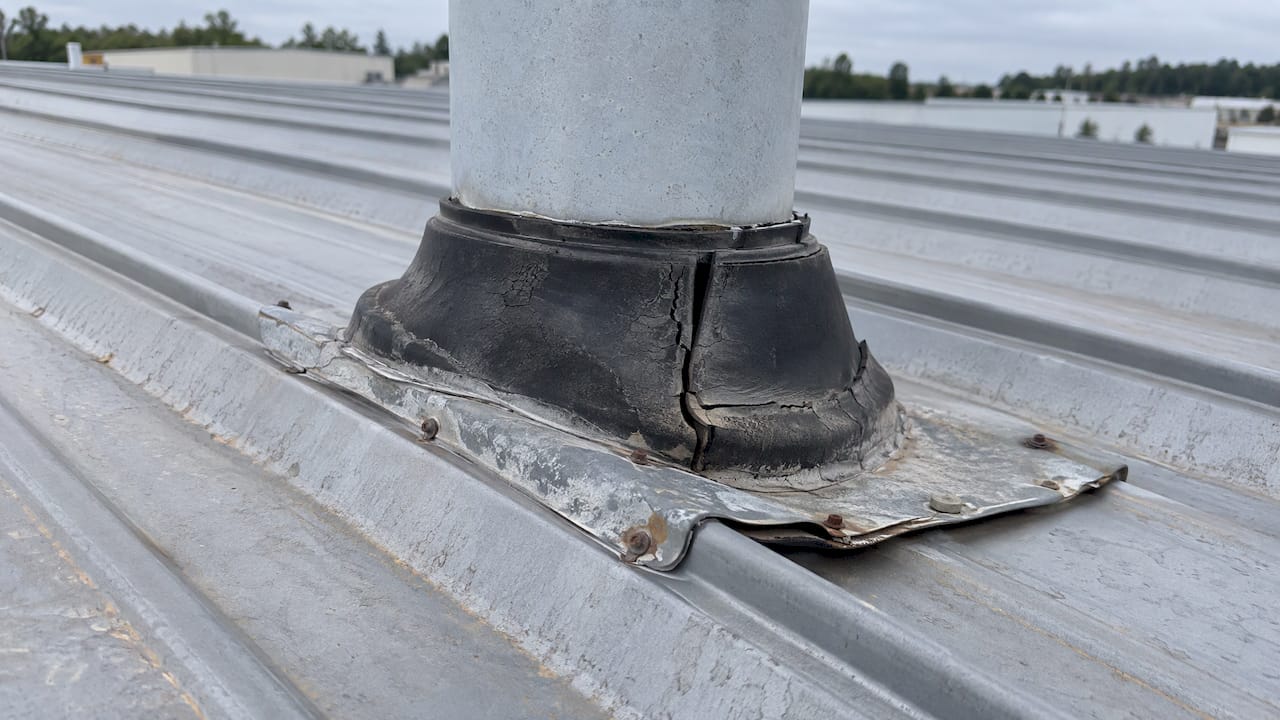
Pipe boots and vent flashings take the heat and ultraviolet exposure that panels shrug off, so they often wear out before the roof does. Worn boots, cracked sealant around chimneys and open flashing laps are replaced or rebuilt, not simply smeared over. Our page on roof flashing repair covers causes, costs and when flashing should be replaced.
Replace damaged panels
When a panel is punctured, heavily corroded or deformed by wind or hail, replacing it is more durable than patching it. We replace shingle, tile and metal panels as part of our roof repair work, and we handle storm and wind damage restoration for roofs hit by severe weather.
Address corrosion early
Surface rust on a small area can be cleaned, treated and protected. Widespread corrosion changes the question from repair to how much of the roof can be saved. Preventive attention matters here, and there are approaches to stop metal roof corrosion without a full reroof in demanding environments when caught early enough.
What metal roof repair costs
Price depends on the type of damage, the roof’s material and pitch, how accessible the area is and how much of the roof shares the same problem. We do not publish fixed prices because every roof is different, and we give written estimates after looking at the roof.
For a general benchmark, HomeGuide’s 2026 cost guide reports that metal roof leak repairs average $200 to $1,000, with leaks from rust or corrosion costing up to $3,000. The same guide gives these ranges for common jobs:
| Repair | Published average range |
|---|---|
| Replace screws or fasteners | $150 to $1,000 |
| Leak repair (residential) | $200 to $1,000 |
| Reseal loose seams | $250 to $1,100 |
| Replace panels (per square foot) | $3 to $14 |
| Recoating or membrane | $750 to $10,000 |
These are national averages published for 2026 and shift with material and labor costs, so treat them as a way to judge whether a quote is in a sensible range, not as a price for your roof. Material matters: the same guide lists copper, zinc and stainless steel panels at higher per-square-foot repair costs than galvanized steel or corrugated metal.
Two factors raise cost more than any other. The first is waiting: a $300 fastener repair becomes a decking and insulation repair after months of water intrusion. The second is a repair that treats the symptom. A cheap patch that fails in a season costs you twice.
If your insurer covers sudden storm damage, document the damage and report it promptly. Policies differ on gradual wear, so read yours or ask your agent what applies to your roof.
Repair, restore or replace?
Most roofs with isolated leaks are repair candidates. The decision changes when problems spread across the roof.
| Situation | Usual direction |
|---|---|
| One or two leaks at a vent, seam or fastener line | Repair |
| Widespread backed-out fasteners and dried sealant | Systematic re-fastening and resealing |
| Localized panel damage from a storm | Panel replacement and repair |
| Corrosion across large areas, repeated leaks, deteriorated panels | Discuss replacement or an upgrade |
Benchmark states that a metal roof should provide 25 to 40 years of service if it is regularly inspected and maintained, while neglect or improper repairs can shorten that life. A roof in its later years that keeps leaking in new places may be better served by an upgrade. We handle roof upgrades, including impact-resistant metal roofing, waterproofing for valleys and transitions, and ventilation improvements, as well as full replacements.
Residential and commercial metal roofs
The leak mechanisms are the same on a house and a warehouse: fasteners, seams and penetrations. The difference is scale and consequences. A commercial roof has more penetrations (rooftop units, exhaust fans, skylights), larger seam runs and tenants or inventory below, so a small leak can interrupt operations. Property managers also need records that show maintenance was done on schedule.
For commercial properties, we offer commercial preventative maintenance plans and commercial roof replacement. Our guide to a commercial roof inspection schedule and checklist shows what a thorough visit covers.
Keeping the next leak from happening
Maintenance is cheaper than emergency repair, and on metal it is mostly about watching the details:
- Inspect the roof at least twice a year and after every major storm.
- Re-tighten or replace backed-out fasteners before the washers fail.
- Reseal seams and flashing as sealant ages, not after it fails.
- Keep gutters, valleys and drainage paths clear so water does not stand on panels.
- Remove debris and trim branches that scratch the finish.
- Keep dated photos and written reports of every inspection and repair.
Our roof inspection and maintenance plans, gutter cleaning and drainage solutions, and fascia and soffit repairs cover most of that list. For more on timing, see how to extend your roof’s lifespan and our guide to roof inspection services.
Our perspective on metal roof repair
We have more than 20 years of roofing experience in Florida and Missouri, two places where the weather tests a roof in different ways: hurricanes and sustained wind in Florida, severe storms in Missouri. On a metal roof, those conditions show up as loosened fasteners, stressed seams and tired flashing long before a panel fails.
That is why we start with a diagnosis, not a tube of sealant. We look for the cause, explain what we found in plain terms, and give you an honest estimate for the repair that fits. If the roof needs a few fasteners and a reseal, that is what we recommend. If it has reached the point where an upgrade makes more sense, we show you why.
Our crews are licensed and insured, and we keep you informed throughout the project. A metal roof is a long-term investment, and the best way to protect it is to repair small problems properly while they are still small.
the author
Get your metal roof repaired by a licensed team
If your metal roof is leaking, showing rust or came through a storm with questions, we can inspect it, find the source and repair it. We serve residential and commercial properties in Florida and Missouri, from emergency leak detection and repair to metal panel replacement, flashing and sealant work, and ongoing maintenance plans.
See our roof repair services or start from our roofing services overview to request an estimate.
FAQ
Can a leaking metal roof be repaired, or does it need replacing?
Most leaks can be repaired because they come from fasteners, seams, flashing or small damaged areas. Replacement becomes the better choice when corrosion is widespread, panels are badly deformed or leaks keep appearing in new places. An inspection tells you which applies.
How long does a temporary fix last?
A temporary fix is a short-term measure to limit damage until a permanent repair is made. It will not address a failed seam or worn flashing, so schedule the permanent repair soon. Meanwhile, keep water contained inside and dry out any wet insulation.
Is it safe to fix a metal roof leak myself?
Wet metal is very slippery and falls from roofs are serious, so stay off the roof in rain and leave steep or high roofs to professionals. From the ground and attic you can safely find stains, take photographs and contain water. The repair itself is best done by a licensed, insured roofer.
Will insurance cover a metal roof leak?
Often, sudden damage from a storm is covered, while gradual wear and lack of maintenance usually are not. Coverage depends on your policy, so photograph the damage, report it promptly and ask your insurer what applies. We can document the roof’s condition to support your claim.
How often should a metal roof be inspected?
Twice a year and after severe storms is a sound routine. Regular inspections catch loose fasteners and aging sealant before they leak, and they keep the roof on track for its full service life.
Sources
- Metal Roofs, Florida Division of Emergency Management
- A Systematic Approach to Metal Roof Inspections: Part 1, Benchmark Inc.
- Why Is My Metal Roof Leaking?, Benchmark Inc.
- Assessing and Repairing Leaky Roofs, University of Wisconsin Extension
- How Much Does Metal Roof Repair Cost? (2026), HomeGuide
Recommended
- Roof Flashing Repair: Causes, Costs and When to Replace
- Affordable Roof Repair Services for Persistent Leak Problems
- Roof Leak Repair: What You Need to Know
- Roof Leak Detection: How to Find the Source and What Comes Next