 Post by
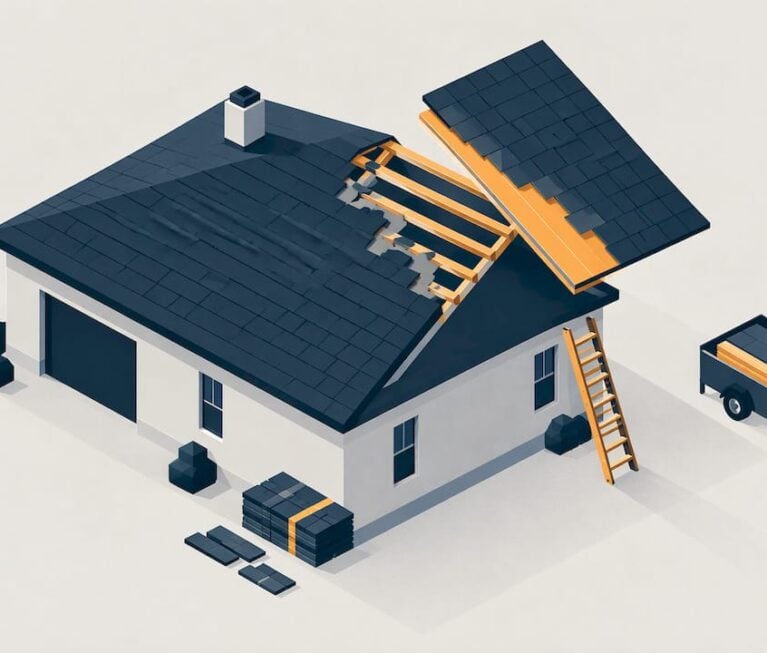
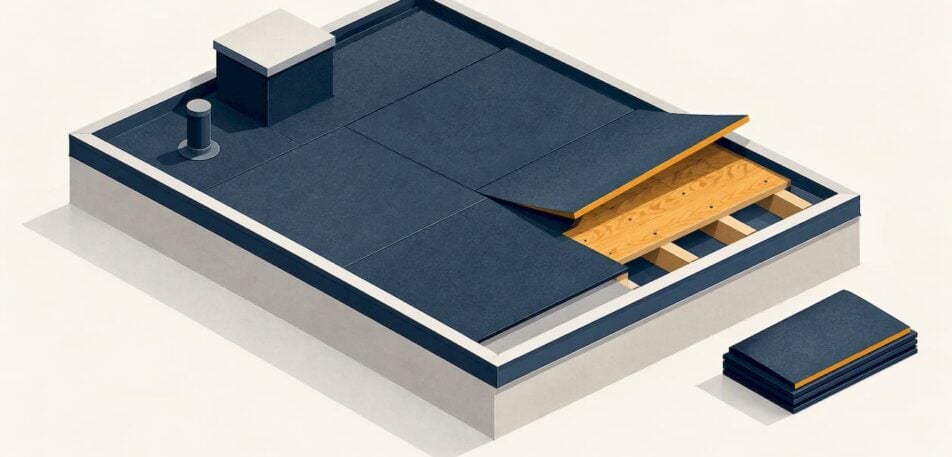
Roof decking replacement means cutting out the damaged boards or panels under your shingles, tile or metal and fastening sound ones to the framing before the roof is covered again. The deck is only visible when the old roofing comes off, so the real scope of the job is usually confirmed during tear-off. The best way to avoid surprises is to hire a licensed, insured roofer who explains the likely deck repair before work starts and tells you what they find while the roof is open. That is how we approach roof repair and replacement at GenX Roofing, for homes and commercial buildings in Florida and Missouri.
This guide covers what decking is, how to tell it has failed, how the replacement is done step by step, what drives the price, when a permit is needed, what to check with your insurer, and how soffit and eaves damage fits in.
TL;DR
- Roof decking (also called sheathing) is the plywood or OSB layer that carries the roof’s load and gives the roofing something to attach to. Soft, swollen, crumbling or delaminating wood must be replaced, not covered over.
- Damaged decking can often be replaced in sections, with panels of the same thickness fastened to the framing, but the cause of the moisture must be fixed or the new wood will fail too.
- Decking is usually priced once the roof is opened, because the real extent of rot is hidden under the roofing. Ask how extra sheets will be handled before you sign.
- Permit rules are local. In Springfield, Missouri, for example, replacing more than 32 contiguous square feet of deck needs a permit and an inspection before the new sheathing is covered.
- Rot at the eaves often points to a roof edge, gutter, flashing or ventilation problem, and soffit and fascia are usually repaired in the same visit.
Table of Contents
- What roof decking does
- Signs your decking needs replacement
- Do you need a full roof replacement, or only new decking?
- How roof decking is replaced, step by step
- What affects the cost of replacing roof decking
- Permits and inspections
- Insurance: what to check before work starts
- Eaves water damage and soffit repair
- Choosing who does the work
- Our perspective on decking
- Getting your roof decking looked at
- FAQ
- Sources
What roof decking does
Roof decking is the structural surface fixed over your rafters or trusses. The roofing industry’s Roofing Practices Manual describes it as the component that transfers live and dead loads (the weight of the roof itself, plus snow, wind and people) to the supporting members and serves as the base the roof system attaches to. On most houses it is plywood or oriented strand board (OSB), and Virginia Cooperative Extension notes that sheathing also gives lateral support to the structure and forms the surface for moisture barriers.
That is why deck condition matters more than its low profile suggests. Shingles, tile and metal panels are only as secure as the wood they are fastened to. The same manual says a deck should be smooth, straight and dimensionally stable. A deck that has swollen, sagged or softened cannot hold fasteners or keep a roof flat, so even a brand-new roof laid over it will not perform the way it should.
Signs your decking needs replacement
You rarely see decking directly. You see its symptoms from the attic, the ceiling and the roof surface.
From the roof:
- Spots that feel soft or spongy underfoot
- Sagging between rafters or a wavy roof plane
- Shingles that lift, buckle or will not stay flat
From the attic:
- Dark stains or damp patches on the underside of the deck
- Daylight through boards, or wood that looks crumbly
- Wet insulation, mold or a musty smell
From the wood itself: The City of Springfield, Missouri’s roofing bulletin lists soft or spongy wood, swelling or buckling, plywood delamination (layers peeling apart), and crumbling or flaking wood as signs of damage, and states that deteriorated or damaged decking must be replaced.
A single stain does not mean the whole deck is gone. It does mean someone should look at the cause. Our guides on the signs your roof needs repair or replacement and how to recognize roof damage early walk through what to check from the ground and the attic. If the signs point to an active leak, roof leak detection is the first step, because the deck is only the place where the water shows up.
Do you need a full roof replacement, or only new decking?
Not always. The U.S. Department of Energy’s housing research partnership advises that localized sheathing damage can be fixed by replacing the affected panels with ones of the same thickness and fastening both new and existing sheathing to the framing, according to its roof repair guide. So a small area of rot around a vent or valley can be handled as a repair.
The picture changes when:
- The roofing is near the end of its life. Opening the roof to replace decking and then re-covering it with old, worn material means paying for access twice.
- Soft areas are spread across several slopes, which suggests a ventilation, flashing or long-term leak issue.
- A storm has soaked large parts of the roof.
In those cases, it usually makes sense to replace the roof and repair the deck as part of one project. Our page on roof installs and full replacements covers replacements for homes and commercial buildings, and our roof shingle replacement guide explains how to weigh repair against replacement.
How roof decking is replaced, step by step
Here is the sequence a careful crew follows, and where each step tends to go wrong.
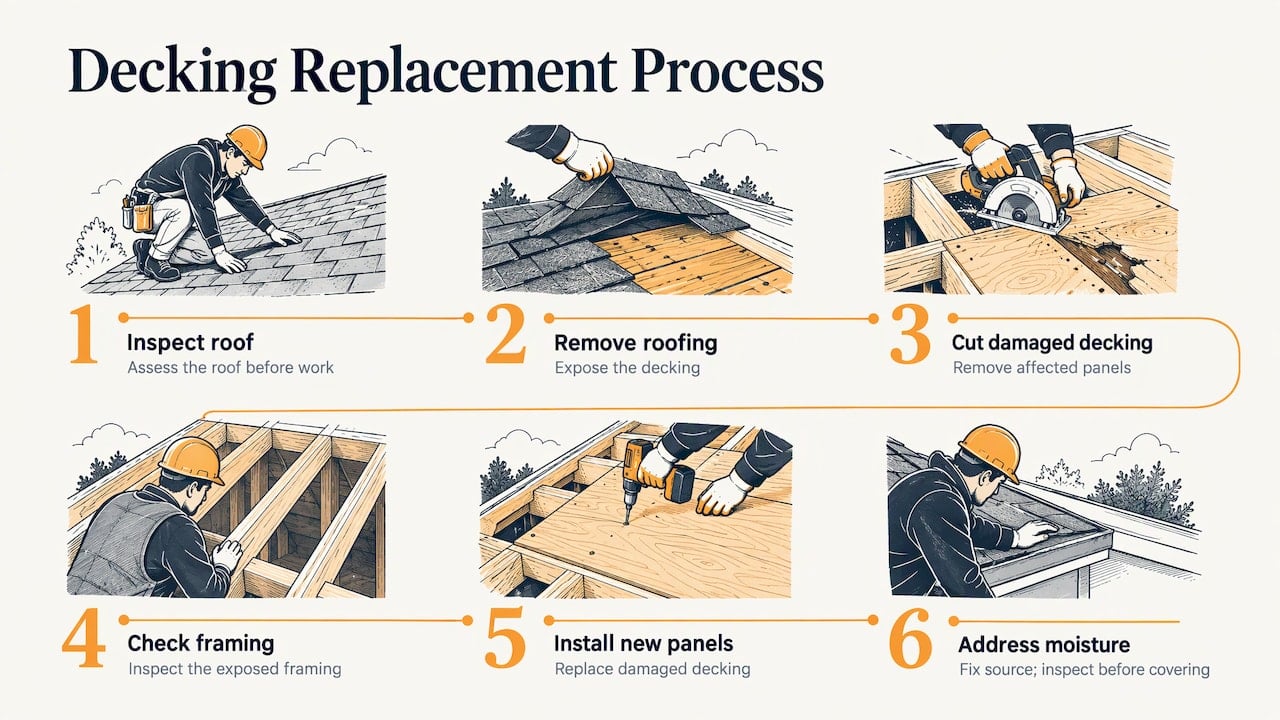
1. Inspect before you quote
The attic side of the deck shows stains, damp insulation and daylight, and the roof side shows soft spots. This gives a reasonable estimate of the problem, but not a final count. A good contractor tells you up front that the number of replaced sheets is confirmed once the roofing is off.
Where it goes wrong: a quote that says nothing about decking, or that promises a fixed total without explaining what happens if more rot turns up. At GenX Roofing we stand behind transparent communication throughout the project and honest, accurate estimates, so the decking conversation happens before the first shingle comes off.
2. Remove the roofing to expose the deck
Shingles, tile or metal panels, plus the underlayment, come off the affected area. Only then can soft or stained areas be marked and checked properly.
3. Cut out the damaged decking
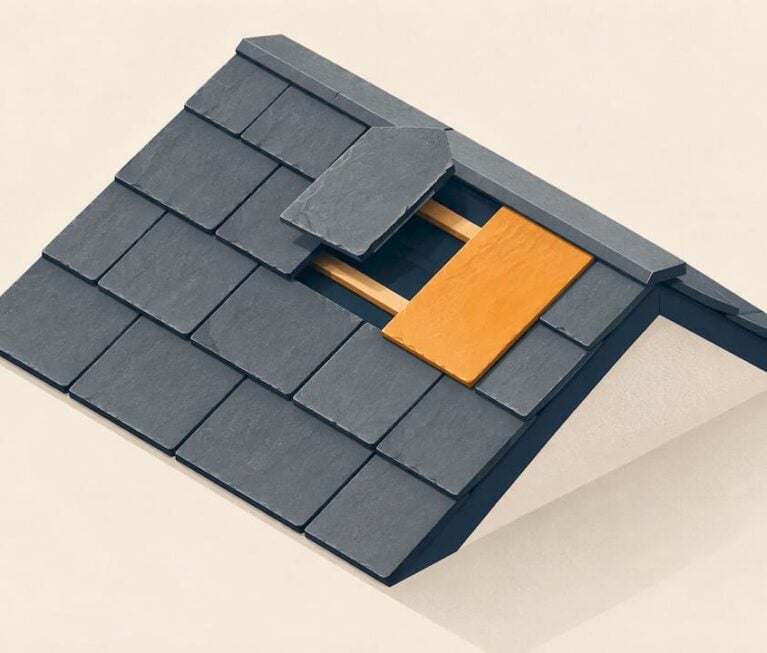
Crews cut back to sound wood, ideally so that new panel edges land on rafters or trusses. The goal is to remove all the compromised material, not just the visible hole.
Where it goes wrong: patching only the obvious soft spot and leaving wood that is already delaminating next to it. The research partnership’s guidance is clear that unsound storm-damaged materials and materials that cannot dry before being covered should not be reused. Wet wood sealed under new roofing invites the structural, mold and appearance problems the guide warns about.
4. Check the framing
Once the deck is open, the rafters or trusses underneath can be examined. Water that rotted the deck may have reached the framing, and damaged framing members need to be dealt with before new sheathing goes on top.
5. Install the new panels
Replacement panels should match the thickness of the existing deck and be fastened to the framing, as the same roof repair guide advises. Mismatched thickness leaves a visible step or dip that shows through shingles and weakens the area around the repair.
6. Fix the cause
This step decides whether the repair lasts. Common causes include failed flashing around vents and chimneys, worn roofing, clogged gutters, poor attic ventilation and ice dams. Our roof repair work includes flashing and sealant repair around vents and chimneys, shingle, tile or metal panel replacement, and gutter cleaning and drainage solutions, so the source of the moisture and the damaged deck can be addressed together.
7. Inspect, then cover
Where a permit applies, an inspector may need to see the new sheathing before it is hidden. Then underlayment goes down, followed by the finished roofing.
What affects the cost of replacing roof decking
There is no honest single price for decking, because the biggest variable is hidden until the roof is open. These are the factors that move the total:
- How much deck is damaged. A few sheets around a vent is a very different job from a whole slope.
- Material. Plywood and OSB are priced differently, and the right choice depends on the existing deck and the roof design.
- Roof pitch, height and access. Steep or complex roofs take more labor and more safety setup.
- Number of roofing layers and type. Tile and metal take different handling than shingles.
- Framing repairs. Rotted rafters add carpentry.
- Permits and inspections. Local rules vary, as covered below.
- Timing. Doing deck work during a roof replacement is usually more efficient than opening the roof separately later.
We do not publish set prices for roofing work, because they depend on the specific roof. When you request an estimate, ask how additional damaged decking found at tear-off will be measured and communicated to you before it is added. That one question tells you how a contractor handles surprises.
Permits and inspections
Permit rules for decking are set locally, not nationally. As one example, the Springfield, Missouri bulletin says a permit is required when structural elements are altered or replaced, or when more than 32 contiguous square feet of deck sheathing is replaced. It also says an inspection is required for permitted work and must happen before new roof sheathing is covered, and that photographs can be submitted at final inspection to satisfy it in some cases.
That is Springfield’s rule, not a universal one. Your city or county building department sets the requirement for your address, and it can differ across the Florida and Missouri communities we serve. Permits and inspections are a step the law gives to the local authority, so they are part of the process, and the contractor should know what applies where your property is.
Insurance: what to check before work starts
Whether a policy pays for decking depends on the cause of the damage and the policy’s terms, and only your insurer can confirm that. Sudden storm or wind damage is handled differently from long-term moisture or wear, so read your policy or ask your agent.
The practical guidance is consistent. The research partnership’s guide recommends preserving damaged materials until an insurance adjuster confirms the loss, while still protecting the building from further water damage. In practice:
- Photograph the damage from inside and outside before anything is moved.
- Arrange temporary protection so water does not make the damage worse.
- Keep removed material until the adjuster has seen it, if you can store it safely.
- Ask your roofer for a written description of what was damaged and what was replaced.
We do storm and wind damage roof restoration in both Florida and Missouri, and our team can document the roof’s condition and the work that is needed.
Eaves water damage and soffit repair
The edge of the roof is where deck, fascia, soffit and gutters meet, so it is where moisture problems tend to show up first. The Department of Energy’s Guide to Durable Attics lists roof leaks or improperly installed flashing, water vapor without proper ventilation, and ice dams as ways moisture enters an attic. Possible signs include warped or rotted soffit or fascia, bubbled paint, worn or warped shingles at the roof edge, wet attic insulation near the eaves, mold, and warped or rotting wood in the attic.
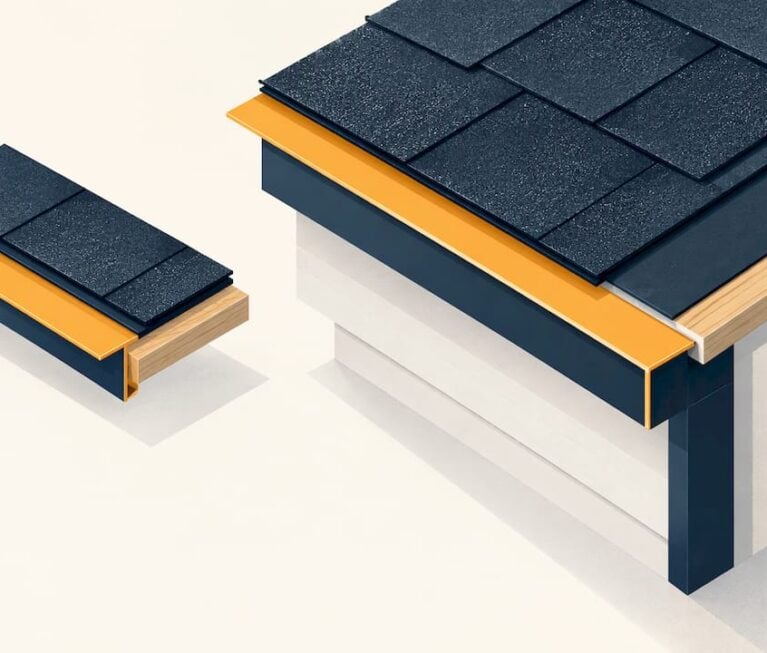
The International Association of Certified Home Inspectors’ roof inspection guide recommends checking for damp or rotten-looking soffit, and says a properly fitted drip edge helps direct water away from sheathing and trim. Its exterior inspection guide adds that rot can have several moisture sources, including roof or gutter leaks, gaps, condensation and poor drying, and that the source should be identified when rot is found. If you also want to understand how soiled or stained soffit and fascia are kept clean, this fascia and soffit cleaning guide covers the surface care side.
Soffit repair and replacement
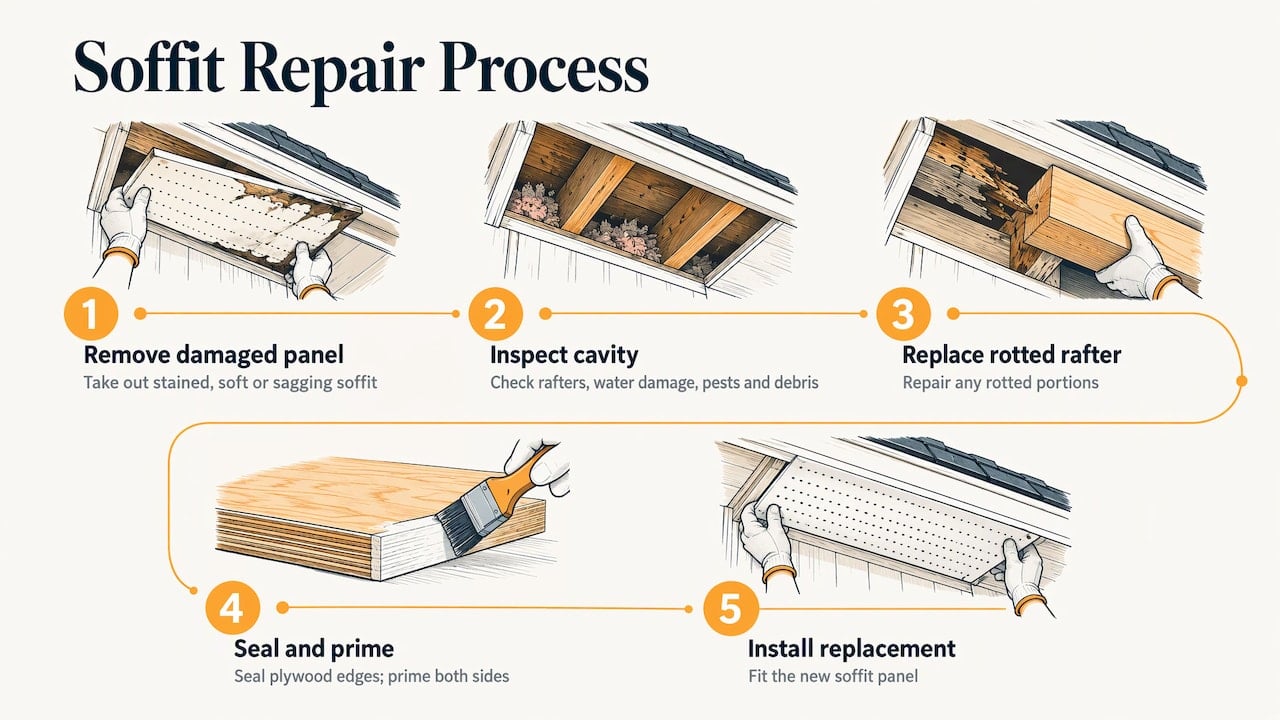
Soffit is the underside of the roof overhang. A panel that is stained, soft or sagging usually needs to come out. This Old House’s soffit repair guide describes removing the damaged panel, inspecting the cavity and rafters, replacing rotted portions of rafter, sealing plywood edges and priming both sides of the replacement soffit before installing it. It also notes that removing a damaged soffit can reveal more extensive water damage, pests or debris, so the cavity should be inspected before anything is rebuilt.
That last point is why soffit and deck repairs are best planned together. If the roof edge deck is wet, the soffit below it will keep failing no matter how many times it is replaced. Our roof repair services include fascia and soffit repairs, along with gutter and drainage work, and our roof upgrades include ridge vents, soffit vents and powered fans where poor airflow is feeding the moisture. For attic-side damage, see our guide to attic water damage repair.
Choosing who does the work
Decking is the part of a roof that nobody sees once the job is finished, so the contractor’s habits matter. Look for:
- A license and insurance that cover the work at your address.
- A clear explanation of how hidden damage is handled, including how extra decking is measured and approved.
- Repairs that address the cause, not only the damaged wood: flashing, drainage, ventilation and roofing condition.
- Local knowledge: hurricane-driven wind and humidity in Florida, and storms and temperature swings in Missouri, stress roofs differently.
- Permit handling that matches your local building department’s rules.
We have more than 20 years of experience and work on both residential and commercial properties, which matters when a commercial flat roof deck and a pitched home roof need different approaches. Our guide on how to find the best roof repair contractor goes through the questions to ask.
Our perspective on decking
We think of decking as the part of the roof where honesty matters most. Homeowners and building managers cannot see it, cannot easily judge it, and often only learn its condition when the roof is already open.
That is why we put communication first. We believe an estimate should say plainly what is known, what is likely, and what will be confirmed during tear-off, so that nobody is surprised by a conversation on the roof. Our crews are licensed and insured, and our work is built for the weather your property actually faces, from Florida’s hurricane season to Missouri’s storms.
We also believe a deck repair should never be treated in isolation. When we repair or replace a roof, we look at the flashing, the gutters, the ventilation and the roofing above, because those are the reasons wood fails. Fixing wood without fixing the reason is the repair that comes back.
For property managers and business owners, the same thinking applies to maintenance. A regular inspection finds a damp edge or a loose flashing long before it becomes a deck replacement.
the author
Getting your roof decking looked at
If you have a soft spot, a stained ceiling, a sagging section or rot at the eaves, the next step is a professional look at the roof and attic. We handle roof repair, full roof replacement and roof upgrades for homes in Florida and Missouri, and commercial roof replacement and preventative maintenance plans for business properties. Our inspection and maintenance plans are designed to catch moisture problems before they reach the deck.
To talk through your roof, start at genxroofing.com and tell us what you are seeing.
FAQ
Is it expensive to replace roof decking?
It depends mostly on how much of the deck is damaged, the material, and how hard the roof is to reach. A few sheets cost far less than a full re-deck. Because the extent of rot is often only clear once the roofing is off, ask any contractor how extra decking will be measured and approved.
Does a new roof mean new decking?
Not necessarily. Sound decking can stay, while soft, swollen, delaminated or crumbling sections are replaced. The Springfield, Missouri bulletin says deteriorated or damaged decking must be replaced, so what matters is the condition of the wood once the old roofing is removed.
Will insurance pay for new roof decking?
That depends on your policy and the cause of the damage, and your insurer makes the decision. Sudden storm damage is treated differently from long-term wear or moisture. Photograph everything, protect the roof from more water, and keep damaged material until the adjuster has seen it.
Can you put new roof decking over old?
No. Damaged panels should be cut out and replaced, with new sheathing of the same thickness fastened to the framing. Laying new wood over rotted or wet decking traps the problem under the roof and leaves the structure unsupported where it matters most.
When does a soffit need to be replaced?
Replace a soffit when it is soft, stained, sagging or rotted. Check the cavity and rafters when it comes out, and find the moisture source, whether a roof leak, gutter overflow, flashing gap or poor ventilation, so the new panel does not fail the same way.
Sources
- Roof Decks, RCABC Roofing Practices Manual
- Energy Series: What about the Roof? (Virginia Cooperative Extension)
- Roofing, Roof Recover, Roof Replacement, and Roof Repair (City of Springfield, Missouri)
- Repairing Roofs and Ceilings: How To’s for the Handy (Partnership for Advancing Technology in Housing)
- Guide to Durable Attics (U.S. Department of Energy)
- How to Perform Roof Inspections (InterNACHI)
- How to Inspect the Exterior (InterNACHI)
- Soffit Repair: Tips From a Pro (This Old House)
- Fascia and Soffit Cleaning: The Complete Guide
Recommended
- Roof Shingle Replacement: When to Repair, When to Replace
- How to Recognize the Signs of Roof Damage Before It’s Too Late
- Replacing Your Roof in 2026? Get a Clear Timeline