 Post by
A licensed roofing contractor is a company that holds the credential your state, county or city requires for roofing work, carries the insurance that goes with it, and can show both before anyone climbs onto your roof. The rules differ by state, so the safest approach is to look the contractor up on the official database yourself, ask for current proof of insurance, and get the scope, price and warranty in writing. We are GenX Roofing, a licensed and insured contractor serving homes and commercial buildings in Florida and Missouri, and this guide walks through the same checks we would want any owner to make.
TL;DR
- “Licensed” means a government body has approved the company. Requirements, and which body issues them, change from state to state and sometimes from city to city.
- Verify the license on your state’s official lookup, then confirm general liability and workers’ compensation coverage with a current certificate of insurance.
- Repairs, storm restoration and replacements all count as roofing work, so the same checks apply to a small leak fix and a full new roof.
- Put the exact work, materials, warranty, schedule, total price and payment schedule in a written contract, and never pay everything up front.
- Treat unsolicited door knocks, cash-only terms, deductible-waiver offers and vague estimates as warning signs.
Table of Contents
- What “licensed” actually means for a roofer
- How to verify a roofing license in minutes
- What “insured” should mean on your job
- Do the rules apply to repairs as well as new roofs?
- Beyond the license: what to check before you sign
- Warning signs that a license or insurance can’t be trusted
- Our perspective
- Working with GenX Roofing
- Choosing the right service for your situation
- A worked example: comparing three bids
- FAQ
- Sources
What “licensed” actually means for a roofer
The word sounds simple, but it covers different things depending on where you live. In some states a roofer needs a state license. In others the state only asks for registration, and local governments handle the rest. Knowing which system applies to your address is the first step in a sensible hire.
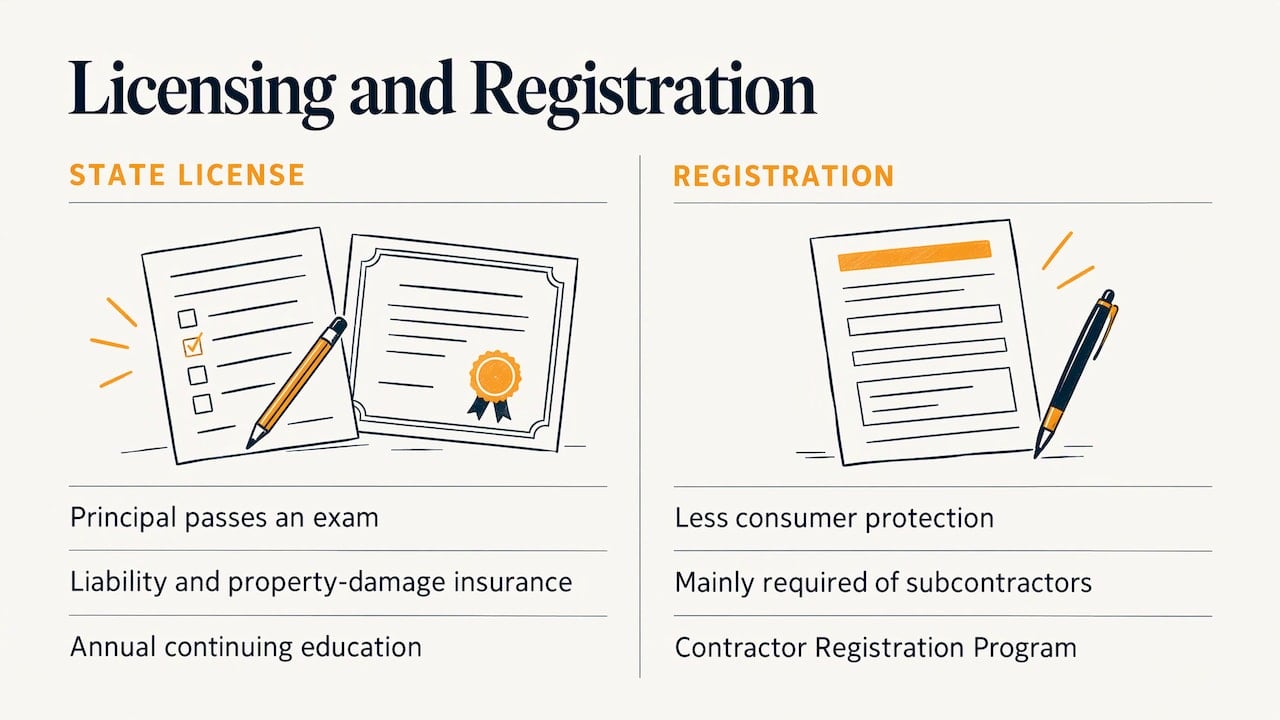
The distinction matters because the two are not equivalent. Minnesota’s Department of Labor and Industry explains that licensing is distinct from registration: registration does not give consumers the same level of protection and is mainly required of subcontractors. A state license, by contrast, indicates the company met requirements that include a principal passing an exam and carrying liability and property-damage insurance. Licensed contractors in that state must also complete annual continuing education.
The same state spells out who needs what. Residential contractors doing roofing work must hold a residential roofer, residential building contractor or residential remodeler license, while roofing subcontractors register through the Contractor Registration Program instead.
Florida and Missouri work differently
Because we work in both states, we hear this question often. Florida runs a state-level system, and its Office of the Insurance Consumer Advocate tells homeowners to verify an active Florida license through MyFloridaLicense, the state portal. In Missouri, licensing expectations for roofers are generally set at the city or county level, so the office that issues building permits for your address is the place to ask what applies to you.
If you own property in a state we do not mention, the pattern is the same: find the state licensing board or attorney general page for contractors, and read what it says about roofing specifically.
How to verify a roofing license in minutes
Every state that licenses or registers roofers runs a public lookup. The tools look slightly different, but they answer the same questions: is this company in the database, is the status active, and is there any disciplinary history.
Here are examples of what the official tools offer:
- Louisiana: the State Licensing Board for Contractors says its license search returns current information and can be searched by contractor name, license number, license type or location. Its mobile app also lets you report unlicensed activity.
- Washington: the Department of Labor and Industries lets you search by license number, employer account ID, UBI number or business or owner name.
- Massachusetts: you can check a home improvement contractor’s registration online using a last name, company information or registration number.
- California: the Contractors State License Board’s roofing guide says consumers can verify license status, bond information, workers’ compensation policy information and whether legal actions have been filed against the license.
A simple verification routine
- Get the exact legal name and license number. A reputable contractor puts the number on estimates and contracts. If the name on the truck differs from the name on the contract, ask why before you go further.
- Search the official database, not a directory. Review sites and lead-generation pages repeat the word “licensed” without checking it. The state or local lookup is the source of truth.
- Read the whole record. Look at the license type, the status, the expiration date and any complaints or actions, not just the green “active” line.
- Match the license to the work. A license for another trade does not authorize roofing in states that license roofers separately.
- Check again for a long project. A license that is active in March can lapse before a job that runs into autumn, so a quick second look at the final payment stage costs little.
The Kansas Attorney General’s consumer guidance adds a useful local-government step: ask the building department about permits and inspections, and be wary of a contractor who asks you to pull the permit yourself. Permits protect you because an inspection puts a second set of eyes on the work.
What “insured” should mean on your job
A license and insurance are separate things, and the second is what protects your property and your wallet if something goes wrong on the roof. When people search for an insured roofing contractor, they are usually asking two questions: what coverage should exist, and how do I know it is current?
The two policies to look for
The California licensing board recommends confirming workers’ compensation and general liability insurance and requesting copies of the policies for your project file. Plainly stated:
- General liability responds when the work damages your property or injures someone who is not an employee, such as a neighbor or a delivery driver.
- Workers’ compensation responds when a crew member is hurt. Roofing is physically risky work, and without this coverage an injury on your property can become a dispute that reaches you.
Florida’s consumer advocate gives a clear sequence: verify the license, check workers’ compensation or a valid exemption through the state portal, and request a general liability certificate of insurance before the contractor inspects the roof.
Minimums can be written into the rules
Some states put numbers on it. Oklahoma’s Construction Industries Board states that residential roofing registration requires general liability coverage of at least $500,000, while a commercial roofing endorsement requires at least $1,000,000, and the policy must specifically cover roofing work. That last point is easy to miss: a policy for a different trade may not respond to a roofing claim. Your state will have its own thresholds, so use them as a pattern for what to ask, not as a universal figure.
Confirming coverage is current
A certificate of insurance shows the policy number, the coverage limits and the dates. Check that the dates cover your project and that the insured name matches the company on your contract. Insurers can confirm a policy’s status when you call the number printed on the certificate. Doing this takes ten minutes and is worth it on any job, whether you are replacing a whole roof or fixing flashing.
Do the rules apply to repairs as well as new roofs?
Yes, in the licensing systems we reviewed, roofing work is roofing work. Minnesota’s rules cover any residential contractor performing roofing work, not just those installing a new roof. A leak repair, a few replaced shingles, new flashing around a chimney or storm restoration after a wind event all involve the same ladder, the same roof surface and the same risk of damage.
That is why we apply the same standard to small jobs as large ones. A repair is often when owners are most rushed and most vulnerable to an unsolicited offer, particularly after a storm. If you are in that situation, our guide to what to do and who to call after storm damage lays out the sequence.
Commercial properties add one more layer. Oklahoma, for example, requires commercial roofing qualifying parties to complete four hours of approved continuing education every 36 months. Property managers who oversee several buildings should ask whether the contractor’s credentials cover commercial work specifically, and whether a maintenance plan is available so the same crew knows each roof over time.
Beyond the license: what to check before you sign
A license is the entry requirement, not the whole evaluation. Official consumer guides agree on a handful of further checks.
References, bids and the written proposal
The California board advises hiring only licensed contractors, obtaining at least three references and bids, using a written contract, limiting upfront payment, and withholding final payment until you are satisfied. It also suggests checking completed projects and business details, asking how the work is supervised and quality-checked, and reading the warranty exclusions.
When you compare bids, compare scope before price. Two numbers mean little if one includes tear-off, underlayment, flashing and cleanup and the other does not. Ask each contractor to describe the same job in the same terms.
What the contract should say
The Kansas Attorney General recommends a written contract stating the exact work, materials, warranties, timetable, total price and payment schedule. A useful contract also makes clear who is responsible for permits and code compliance. For a broader look at how to hold any contractor to a contract, this explanation of contractor accountability covers the principle well.
A short checklist you can take into any meeting:
| Item | What to look for |
|---|---|
| License | Number on the contract, active status on the official lookup |
| Insurance | Current certificate for general liability, plus workers’ compensation or a valid exemption |
| Scope | Materials by type, tear-off, flashing, ventilation, cleanup |
| Schedule | Start window, expected duration, weather plan |
| Payment | Staged payments, a limited deposit, final payment after your walkthrough |
| Warranty | Written terms for workmanship and materials, with exclusions explained |
| Permits | Who obtains them and when the inspection happens |
If you want more questions to bring to a meeting, our pages on essential questions to ask before hiring a roofing contractor and how to choose the best roofing contractor for your home go further.
Warning signs that a license or insurance can’t be trusted
Florida’s consumer advocate lists the patterns that tend to precede contractor fraud. According to its guide, the warning signs include unsolicited approaches, full upfront or cash-only payment, deductible-waiver offers, pressure to file a claim, missing proof of insurance or references, invalid licenses, and vague or unusually high or low estimates.
In practice, here is how those look at your door:
- The surprise visit after a storm. Someone you did not call says they spotted damage from the street and can start tomorrow.
- A price that only works today. Pressure to sign immediately is a reason to slow down, not speed up.
- A deductible offer. Promising to cover or waive your insurance deductible is on the Florida list for a reason.
- Missing paperwork. No license number, no certificate of insurance, no written scope.
- A request that you pull the permit. The Kansas guidance flags this specifically.
If any of these appear, step back, verify the license on the official site and get the terms in writing. If you are dealing with an insurance claim for roof damage, our article on whether Florida insurance covers roof replacement in 2026 explains how the claim and the contractor relationship fit together.
Our perspective
We have spent more than 20 years on roofs in Florida and Missouri, and the pattern we see in owners’ questions is that they want to know whether they can trust the person quoting the job. A license number answers part of that. Honest estimates, clear communication through the project and a crew that is licensed and insured answer the rest.
That is why we built our approach around transparency. We explain the scope of work, what the roof needs and why, and we put the estimate in terms an owner can compare line by line. Our roofing is designed to stand up to the weather our regions produce: hurricanes in Florida, storms in Missouri.
We also work on both homes and commercial buildings, so a homeowner with a leak, a business owner planning a replacement and a property manager who wants consistent maintenance can all come to the same team. A good roof is a long-term decision, and we want the first conversation to be useful whether or not it turns into a contract.
the author
Working with GenX Roofing
If you are ready to hire, we offer roof installs, upgrades and repair for residential and commercial properties in Florida and Missouri. That includes full roof replacements, emergency leak detection and repair, storm and wind damage restoration, impact-resistant shingle and metal roof upgrades, ventilation improvements, and roof inspection and maintenance plans. Commercial owners can see our commercial roof replacement and preventative maintenance plans. Our crews are licensed and insured, and we aim to give honest, accurate estimates and keep you informed from the first visit to the final walkthrough.
When you are comparing proposals, share the scope with us and we will walk through it with you in plain language.
Choosing the right service for your situation
The type of project affects what you ask for, so it helps to match the question to the work.
A leak or storm damage
Speed matters, because water spreads inside walls and insulation. This is the moment unsolicited offers multiply, so verify the license and insurance before anyone goes on the roof. Our pages on roof leak detection and emergency roof repair in Tampa Bay describe how we approach it.
A full replacement
A replacement is a larger contract with a larger deposit question. This is where staged payments, a written materials list and a clear warranty matter most. If you are planning the project timing, our 2026 replacement timeline shows what a typical schedule looks like, and our financing guide covers payment options.
An upgrade for durability
Owners in hurricane and storm regions often use a replacement to move to impact-resistant shingles or metal roofing, improve ventilation or add attic insulation. Our roof upgrades page lists these options, and our article on ways to fortify a Florida roof explains the thinking.
A commercial building
For businesses and property managers, the questions extend to the licensing category, continuing education, insurance limits and maintenance. A recurring inspection plan keeps small problems small and gives a manager a record for each building. See our commercial roof repair tips for Florida businesses for more.
A worked example: comparing three bids
Imagine a homeowner with a 25-year-old roof and three proposals. The first is a one-line price on a business card. The second lists materials but not the license number. The third lists the license number, the insurance carrier, the shingle type, the underlayment, the flashing, ventilation, the permit, a payment schedule and the workmanship warranty.
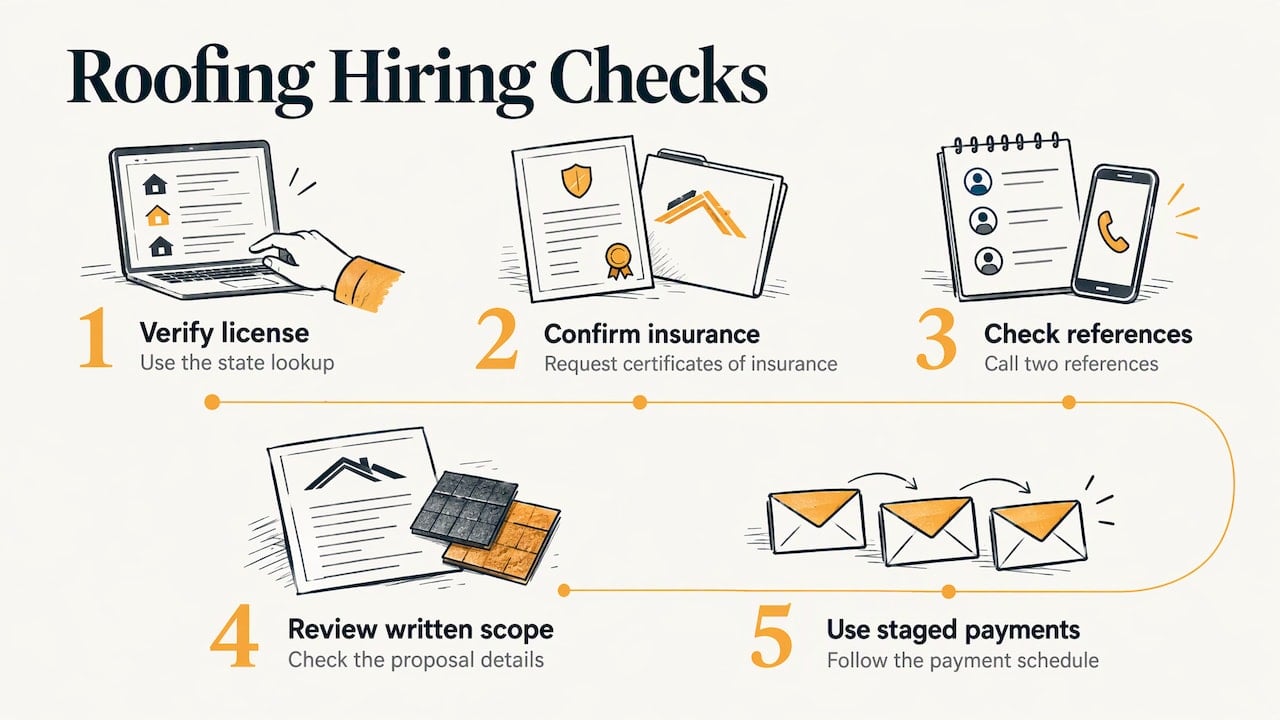
The homeowner then does four things in an afternoon. She looks each company up on the state lookup. She requests certificates of insurance from the two that have passed. She calls two references from the one with the most complete proposal. She asks the building department whether a permit and inspection apply.
Nothing about that process requires roofing expertise. It requires the order of checks the official guides describe: license, insurance, references, written scope, staged payment. The best proposal is usually the one that makes those checks easy.
FAQ
Do roofing companies need a license?
It depends on where the work is done. Some states, such as Florida and Louisiana, run state licensing, while others use registration or leave requirements to cities and counties. Check your state’s contractor board or attorney general page, and ask your local building department what applies to your address.
What is the difference between licensed and insured?
A license shows a government body has approved the contractor to do the work, often after meeting exam and insurance requirements. Insurance is the coverage that responds to damage or injury on the job. You want both, and you confirm each separately: the license through the official lookup, and the insurance through a current certificate.
How do I check that a roofer’s insurance is current?
Ask for a certificate of insurance covering general liability, and check workers’ compensation coverage or a valid exemption. Confirm the dates cover your project and that the name matches the contractor on your contract. California’s roofing guide also suggests requesting copies of the policies for your project file.
Do I need a licensed contractor for a small roof repair?
In the licensing systems we reviewed, repair work falls under the same roofing requirements as installations. Minnesota’s rules, for example, apply to residential contractors performing roofing work generally. A small repair is still work on your roof, so the same license and insurance checks apply.
How much should I pay up front?
Limit it. California’s licensing board advises limiting upfront payment and withholding final payment until you are satisfied. Florida’s consumer guide lists full upfront or cash-only payment as a warning sign. A staged payment schedule written into the contract keeps payments tied to progress.
Sources
- Guide to hiring a residential building contractor, Minnesota Department of Labor and Industry
- Who needs a roofer license? Minnesota Department of Labor and Industry
- Don’t Be A Victim! Prevent Contractor Fraud and Abuse Guide, Florida Office of the Insurance Consumer Advocate
- Verify Licensure, Louisiana State Licensing Board for Contractors
- Verify a Contractor, Tradesperson or Business, Washington Department of Labor and Industries
- A Roofing Contractor, California Contractors State License Board
- Roofing Information for Consumers, Kansas Attorney General
- Roofing, Oklahoma Construction Industries Board
- Contractor Accountability: What It Means and How to Secure It
Recommended
- Discover 7 Key Indicators of a Reliable Roofing Service
- Choose the Right Roofing Contractor: 10 Essential Questions
- Essential Questions to Ask Before Hiring Your Roofing Contractor
- 5 Roofing Contractor Mistakes Homeowners Should Avoid