 Post by
A commercial roof should be replaced when repairs keep adding up, the roof has widespread water damage, or it has reached the end of its service life. Most commercial roofs last about 20 to 30 years, and replacement for flat roofs typically runs $4 to $12 per square foot, before labor and permit effects. This guide covers how to decide, what a project involves, what drives cost, and how to choose a contractor, whether you own an office building, manage a portfolio or lease out rental property.
TL;DR
- Replace rather than repair when leaks are spreading, the membrane or flashing has failed across the roof, or annual repair spending keeps climbing.
- Most commercial roofs last 20 to 30 years, depending on material, climate, drainage, maintenance and installation quality.
- Budget roughly $4 to $12 per square foot for flat roofs and $6 to $15 for sloped roofs, with labor and permits adding 20 to 30%.
- Ask contractors to bid on the same written scope, and consider an independent roof consultant for larger buildings.
- Plan tenant communication, warranty paperwork and a maintenance schedule before the first panel comes off.
Table of Contents
- Repair, recover or replace: how to decide
- How long a commercial roof should last
- Commercial roofing systems compared
- What commercial roof replacement costs
- What happens during a replacement
- Hiring a commercial roofing contractor
- Rental property and multi-tenant roofs
- Our perspective: replace with the climate in mind
- Talk to us about your commercial roof
- FAQ
- Sources
Repair, recover or replace: how to decide
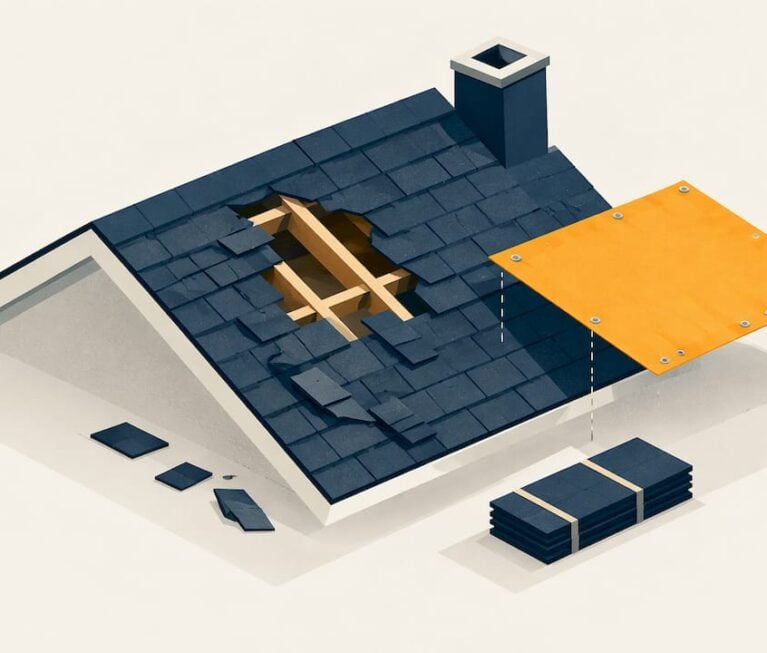
There are three paths. A repair fixes a localized problem. A re-cover, sometimes called a retrofit, leaves the original roof in place and installs a new membrane, or membrane and insulation, over it. A full replacement removes the old roofing down to the structural deck and starts again.
Replacement is often the only workable option when a roof has significant water damage, was installed incorrectly, or has deteriorated beyond repair. A re-cover cannot solve a wet insulation problem, because it traps the moisture under a new layer.
Signs the roof is near the end
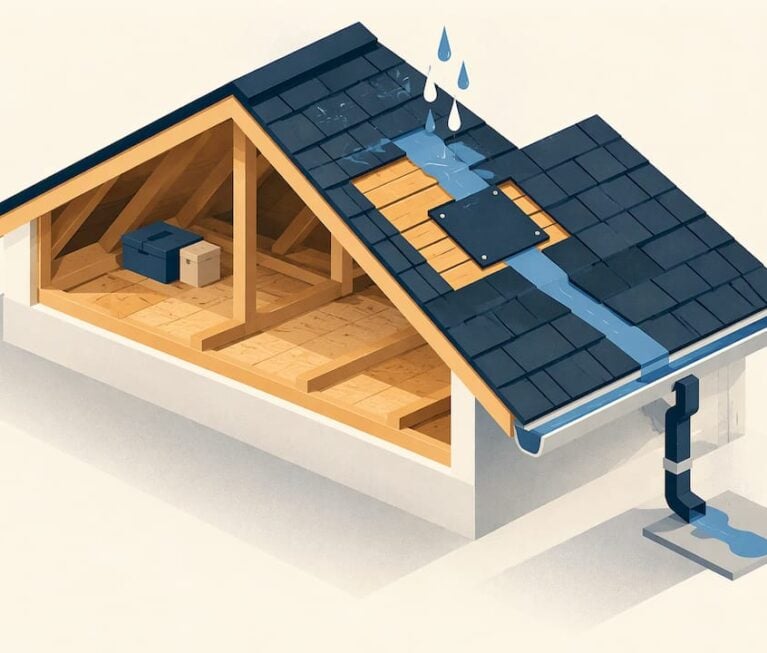
Roof failure is rarely one dramatic event. It more often shows up as more frequent leaks and rising yearly maintenance costs as the roof ages. On a walk-through, look at:
- Flashing around curbs, vents, parapets and penetrations
- The membrane surface: seams, blisters, splits, ponding areas
- Gutters, downspouts and drains, including debris backups and damage
- Interior ceiling stains, damp insulation and recurring repair patches in the same zones
A useful internal rule: if you can name three or more leak locations in the past year, or the same area has been patched repeatedly, ask for a replacement quote next to the repair quote. Comparing the two on paper turns a general worry into a decision you can defend to an owner or lender. Our guides on signs a roof needs repair or replacement and recognizing when a roof needs maintenance go deeper on the early warnings.
How long a commercial roof should last
Service life depends on more than age. Rain, snow, hail, wind, temperature extremes and UV all wear on a roof assembly, and the material matters. Published ranges for common materials run from 5 to 60+ years, with metal at 40 to 60+ years and EPDM at 10 to 15.
Maintenance changes the outcome. Cited studies found service-life reductions of more than one fourth for under-maintained roofs compared with highly maintained ones, and 18 to 20% for heavily trafficked roofs versus lightly trafficked ones. One industry white paper puts the average life of a new low-slope roof at 17 to 19 years, with a proactive life cycle program aiming to stretch that toward 30. It also links premature failure to the absence of such a program more than to the age of the materials.
The practical takeaway: schedule inspections twice a year and after major storms, keep drains clear, restrict rooftop traffic to the necessary trades, and log every repair. That record also helps when you decide whether the next dollar belongs in a patch or a new system.
Commercial roofing systems compared
The right system depends on roof slope, climate, building use and budget. The common options are TPO, EPDM, PVC, modified bitumen, built-up roofing, metal and spray polyurethane foam.
| System | Where it tends to fit |
|---|---|
| TPO | Reflective single-ply for hot, sun-exposed sites; widely used on reroofs |
| PVC | Restaurants and facilities with grease or chemical exhaust |
| EPDM | Cold climates; published life of 10 to 15 years |
| Modified bitumen / built-up | Multi-layer systems for durable low-slope roofs |
| Metal | Long service life, often 40 years or more, for sloped or low-slope structural panels |
| Spray foam | Seamless coverage over irregular roof shapes |
These pairings come from a comparison of seven commercial systems, which also reports that TPO makes up roughly 40% of new commercial construction and 30% of reroofing.
One caution on reflectivity. Facilities guidance warns owners not to pick a material mainly for its reflectance at the expense of the stresses of the local climate, since a poor fit can lead to condensation and related damage. Match the system to your region’s weather first, then compare energy performance. In hurricane or severe-storm regions, ask how the system is fastened and what wind uplift rating the assembly carries. Our article on choosing roofing materials for your business explains the trade-offs in plain terms.
What commercial roof replacement costs
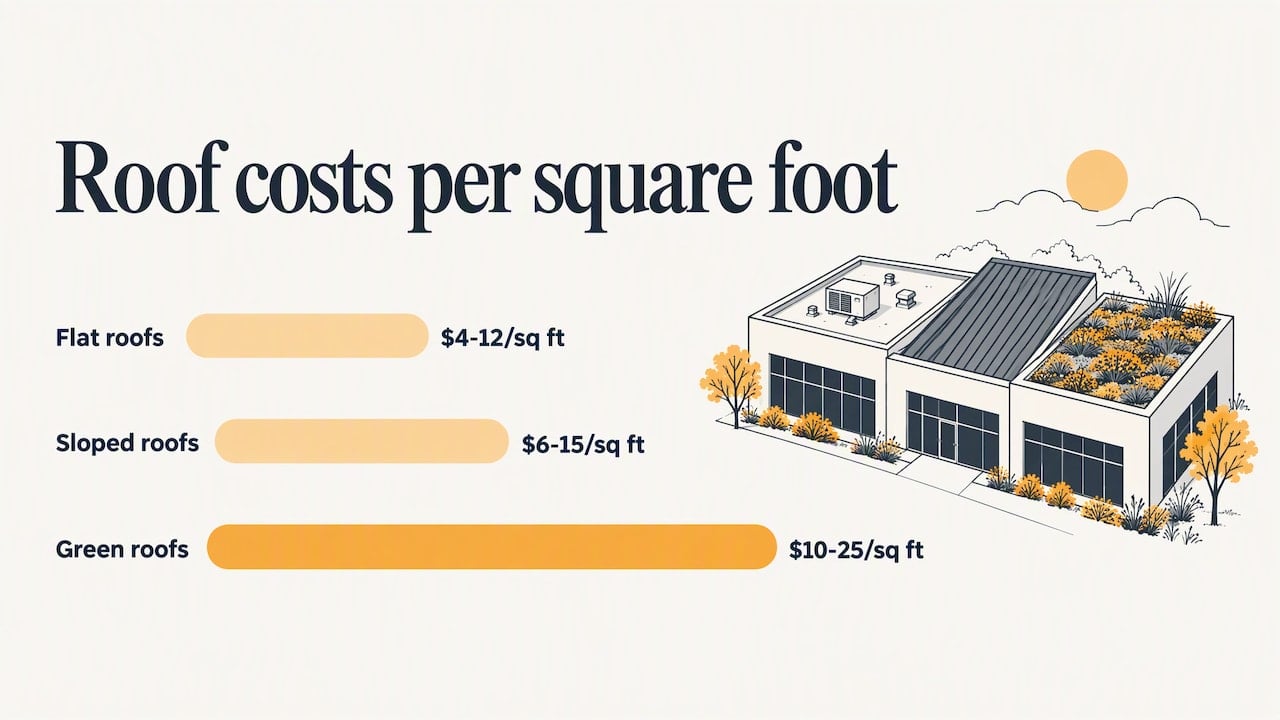
One academic cost summary reports averages of $4 to $12 per square foot for flat roofs, $6 to $15 for sloped roofs and $10 to $25 for green roofs, with labor and permits adding 20 to 30%. Those are ranges, not quotes. A real number depends on:
- Roof area and complexity: penetrations, curbs, parapets and multiple levels add labor.
- System chosen: single-ply, metal and green roofs sit at very different price points.
- Tear-off versus re-cover: removing all material to expose the deck costs more up front, but lets you inspect and repair the deck itself.
- Insulation and drainage: tapered insulation or added drains change the scope.
- Access and schedule: working around occupied space, limited staging areas or after-hours work.
- Local codes and permits: wind, fire and energy requirements vary by jurisdiction.
We do not publish fixed prices for commercial work, because a defensible number requires an inspection of the actual roof. For a worked example of how to think about it, take a 20,000-square-foot flat roof. At the published flat-roof range, the base cost spans $80,000 to $240,000, and the 20 to 30% labor and permit effect would sit on top of that. The width of that spread is the reason a site visit and a written scope matter more than any online average.
Owners also ask whether a new roof lowers commercial property insurance. We can’t promise that, since carriers set their own terms. Ask your agent or broker, before the project starts, which documentation (product ratings, warranty, inspection report) they want to see.
What happens during a replacement
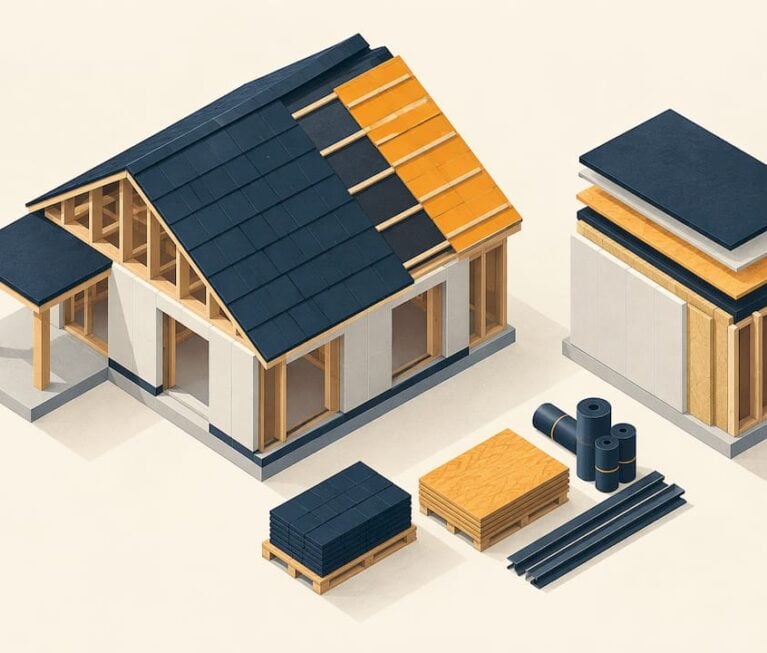
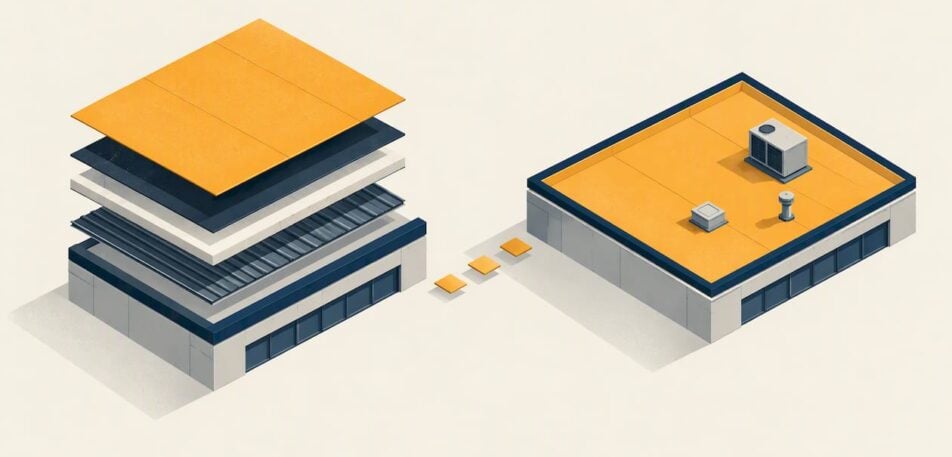
A full replacement removes all existing roofing materials to expose the structural deck before new materials go on. A typical sequence:
- Inspection and scope. Core samples, moisture surveys or a visual review establish what is wet, what can be kept and what the deck needs.
- Design and bids. The scope names the system, insulation, flashing details, drainage and warranty so every bid compares like with like.
- Permits and scheduling. The contractor files permits and plans around business hours, deliveries and weather.
- Tear-off and deck repair. Old layers come off, damaged deck sections are replaced, and the surface is made dry and clean.
- New system installation. Insulation, membrane or panels, flashing and edge metal go in, with seams and penetrations treated carefully.
- Final inspection and closeout. You receive punch-list fixes, warranty documents and maintenance guidance.
For weather-dependent timing, our roof replacement timeline guide walks through the stages, and a Florida-specific roof replacement process overview covers local permitting and storm-season scheduling.
Reducing disruption to occupants
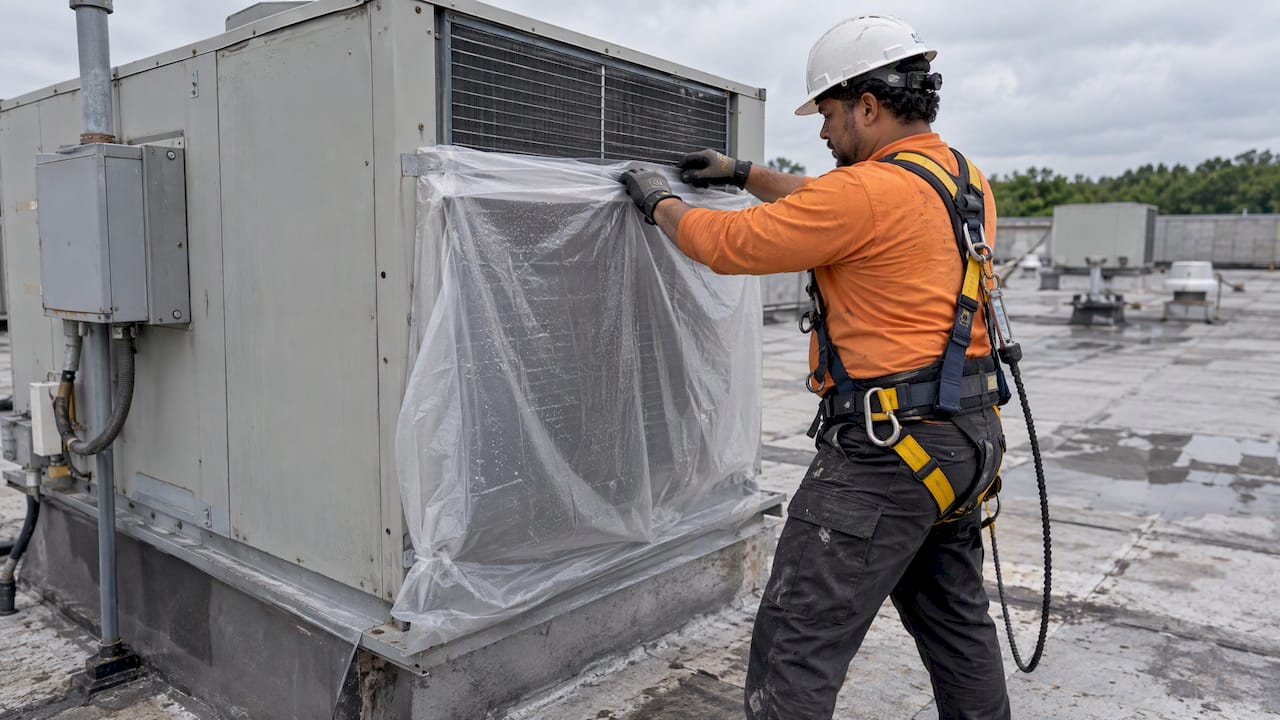
Give tenants and staff written notice of work dates, noise hours, parking and entrance changes. Ask the contractor how they protect HVAC intakes, secure the site overnight and keep the building watertight at the end of each workday. Tell your insurer about the project if your policy requires it.
Hiring a commercial roofing contractor
Start with the basics: license, insurance, references from buildings similar to yours, and a written scope you can compare. Then go a step further on larger projects. An independent consultant, such as a Registered Roof Consultant, architect or engineer, can evaluate existing conditions, prepare design documents for comparable bids and check materials and workmanship during construction. The same source notes that independent consultants help avoid conflicts of interest, since contractors and manufacturer representatives can have a financial stake in particular products.
Questions worth asking every bidder:
- Who will supervise the job daily, and who is your point of contact?
- What exactly is included: tear-off, deck repair allowance, insulation, flashing, drains, edge metal?
- How are unforeseen deck repairs priced?
- What do the manufacturer and workmanship warranties cover, and for how long?
- How will you handle weather delays and keep the building dry?
- What maintenance does the warranty require?
Be wary of bids that are far below the others without a matching scope. The gap is usually in the details: thinner insulation, fewer flashing upgrades or a re-cover where the roof needs a tear-off.
Rental property and multi-tenant roofs
If you own rental or leased commercial property, the lease sets who pays for what. Read the roof, repair, capital improvement and common area maintenance clauses before you plan the budget, and ask your attorney how they apply to a full replacement as opposed to routine upkeep. Many owners treat a replacement as a capital expense, but leases differ, so confirm yours.
For tenant coordination, notify occupants early, share the schedule in writing, identify which units sit under active work areas, and set up a single contact for complaints. For property managers with several buildings, stagger projects and tie each roof to a documented maintenance plan so that no building reaches the end of its life unplanned. Our roof inspection services guide explains what a regular inspection should cover.
Our perspective: replace with the climate in mind
At GenX Roofing, we work in Florida and Missouri, two markets where roofs face hurricanes, high winds and severe storms. After more than 20 years in the industry, we see the same pattern: the best commercial outcomes start with an honest estimate and a scope that names every material and detail. We believe owners are better served when the contractor explains what is wrong, shows what the replacement will include and communicates throughout the project, rather than leaving surprises for the invoice.
We also believe a replacement is the start of a roof’s life cycle, not the end of the conversation. A new system with a documented inspection and maintenance plan has a better chance of reaching the upper end of its expected service life. That is why our commercial work pairs replacement with preventative maintenance plans, and why our crews are licensed and insured and experienced on residential and operational commercial job sites.
If you are weighing repair against replacement, ask for both options in writing. A clear comparison turns a general concern into a useful conversation about budget, timing and risk.
— the author
Talk to us about your commercial roof
GenX Roofing handles commercial roof replacement and commercial preventative maintenance plans for property owners and managers in Florida and Missouri. We start with an inspection, explain the findings plainly and put the scope in writing so you can compare it with any other bid.
See our commercial roofing page to request an assessment, or read about commercial roof installation for Florida businesses if your building is in the state.
FAQ
How much does it cost to replace a commercial roof?
Published averages run $4 to $12 per square foot for flat roofs and $6 to $15 for sloped roofs, with labor and permits adding 20 to 30%. Your price depends on roof size, system, tear-off needs and access. An on-site inspection is the only way to get a reliable number.
How often should a commercial roof be replaced?
Most commercial roofs last about 20 to 30 years, though material, climate, drainage and maintenance shift that range. Replace when leaks and repair costs keep rising, not just when a birthday arrives.
What type of roof do commercial buildings use?
Common systems include TPO, EPDM, PVC, modified bitumen, built-up roofing, metal and spray foam. The choice depends on slope, climate, building use and budget. For example, PVC resists grease and chemicals, while reflective membranes suit hot, sunny sites.
Will a new roof reduce my commercial insurance?
It may affect your terms, but each insurer sets its own rules, so we can’t promise a reduction. Ask your agent which documents they need, such as product ratings, warranty and inspection records, and share them once the new roof is in place.
Sources
- Commercial Flat Roof: Repair vs Retrofit vs Replace
- A Facility Manager’s Guide to Roof Replacement
- Repair, Recover or Replace? Making the Smartest Roofing Decision
- Effective Roof Management: Understanding the Life Cycle
- What Is the Lifespan of a Commercial Roof
- Commercial Roof Asset Life Cycle Management
- Types of Commercial Roofing: 7 Systems Compared
- Maximizing Roof Performance: Climate, Maintenance and Reroofing Strategy
- Commercial Roof Replacement: Cost, Materials & More
Recommended
- Replacing Your Roof in 2026? Get a Clear Timeline
- Key Factors in Commercial Roof Installation Costs
- Know Roofing Cost Factors Before Replacing Your Roof in 2026
- What to Know About the Roof Replacement Process in Florida?