 Post by
You can finance a roof replacement with a personal loan, a home equity loan, a HELOC, a cash-out refinance, an FHA-backed loan, a PACE program or a plan offered through your roofing contractor. The right choice depends on how fast you need the money, how much equity you have, your credit and how much risk you are comfortable placing on your home. This guide explains how each option works, what to compare and what to verify before you sign anything.
TL;DR
- Personal loans fund fastest and are unsecured. Home equity loans, HELOCs and cash-out refinances usually cost less but use your home as collateral.
- A new roof averages about $9,500, and premium materials can push the cost past $45,000, so get a firm written estimate before you apply anywhere.
- PACE repays through your property tax bill, and the CFPB notes an outstanding PACE loan can make selling or refinancing difficult.
- Source your financing independently and compare at least two offers. Never sign blank or rushed paperwork.
Table of Contents
- What a roof replacement can cost, and why the number matters first
- Roof financing options compared
- How to apply: a practical sequence
- Is it hard to get financed for a new roof?
- What to do if you cannot afford the replacement right now
- Protect yourself before you sign
- How the material you choose changes the loan you need
- Our perspective: finance the right roof, not just the cheapest payment
- Start with a clear estimate
- FAQ
- Sources
What a roof replacement can cost, and why the number matters first
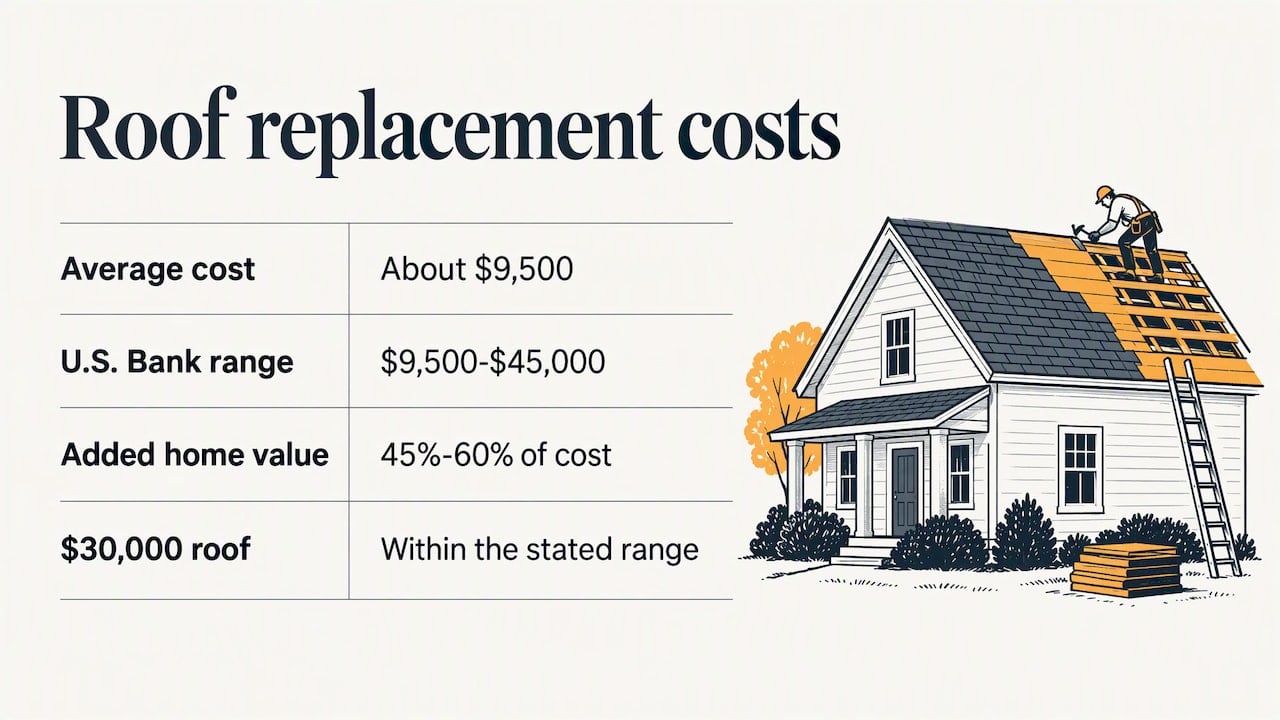
Financing starts with a real number. Homeowners pay about $9,500 on average for a roof replacement, while U.S. Bank puts the range at $9,500 to $45,000 and notes that a new roof returns roughly 45% to 60% of its cost in added home value. That return is real but still leaves an upfront cost most households cannot absorb from a checking account.
So is $30,000 too much for a roof? It sits inside that range, but whether it is reasonable for your home depends on roof size, pitch, the material you choose (asphalt shingle, tile, metal), tear-off layers, decking repairs and local code requirements. Our guide to roofing cost factors before replacing your roof walks through each of those line items so you can read an estimate critically.
Borrowing against a vague number is how people take on a larger loan than they need or a smaller one that leaves the project half funded. Get a detailed, itemized estimate first, then size the loan to it.
Roof financing options compared
The table summarizes how the main options differ. Rates and limits change, so treat the descriptions as a framework and confirm current terms with each lender.
| Option | Collateral | Speed | Main advantage | Main watch-out |
|---|---|---|---|---|
| Personal loan | None (unsecured) | Fastest | No lien on your home | Higher rates; APRs run 6% to 36% |
| Home equity loan | Your home | Slower | Fixed payments, typically lower rate | Foreclosure risk if you default |
| HELOC | Your home | Moderate to slow | Borrow only what you use | Variable rate can rise |
| Cash-out refinance | Your home | Slowest | Often the lowest rate | Replaces your existing mortgage |
| FHA-backed loans | Varies | Slower | Lower credit minimums | Program rules and paperwork |
| PACE | Property tax lien | Moderate | Approval based on home and equity | Can complicate a sale or refinance |
| Contractor financing | Varies by lender | Fast at signing | Convenience, sometimes promotional terms | Rates and fees need close review |
For a wider look at how these choices stack up, this overview of roof financing options for homeowners is a helpful companion.
Personal loans
A personal loan is unsecured, so your house is not pledged. NerdWallet reports that personal loans for roofing carry APRs from 6% to 36% and typically fund faster than home equity loans or HELOCs. Your credit score drives where in that range you land. If a leak is active and you need the work done within days, speed can be worth a higher rate. Prequalifying with several lenders shows your likely rate without a hard credit pull in most cases, so ask each lender about it.
Home equity loans and HELOCs
A home equity loan gives you a lump sum at a fixed rate. A HELOC works more like a credit line you draw on as bills arrive. Both use your home as collateral. The CFPB’s guide to using home equity notes that HELOC rates can adjust with the market, and that failing to make payments or meet other loan requirements can put the property at risk of foreclosure.
That risk is manageable if the payment fits comfortably in your budget, but it is the reason to be cautious about borrowing more than the project requires.
Cash-out refinance
A cash-out refinance replaces your mortgage with a larger one and pays you the difference. NerdWallet notes that it and second mortgages usually offer lower interest than unsecured options. The tradeoff is closing costs and the fact that you reset your entire mortgage, not just fund a roof. It tends to make sense when your current mortgage rate is no better than what you would get on the new loan.
FHA-backed options
Two federal programs come up often. The FHA 203(k) program lets homeowners roll roof replacement and renovation costs into a 15- or 30-year mortgage, with a minimum $5,000 spent on eligible repairs. The FHA Title I program insures smaller home improvement loans; NerdWallet’s summary lists a single-family improvement limit of up to $75,000 and terms up to 30 years, and says loans under $7,500 generally do not require the home as collateral. FHA-insured improvement loans also tend to accept lower minimum credit scores than conventional mortgages. These loans move more slowly than a personal loan, so they suit planned replacements better than emergencies.
PACE financing
Property Assessed Clean Energy (PACE) programs finance qualifying improvements and collect repayment through your property tax bill. In Florida, Florida PACE describes fixed-rate financing added to the tax bill for roofing projects. The CFPB’s PACE guidance is direct about the catch: an outstanding PACE loan can make selling or refinancing difficult, and most lenders will not refinance a mortgage or lend to a buyer while one sits on the property.
If you plan to sell or refinance within a few years, factor that in before choosing PACE. Ask for the full repayment schedule, the interest rate and every fee in writing.
Contractor financing
Many roofers arrange financing through partner lenders. GAF notes that contractor plans may include deferred interest or deferred payments, terms from 2 to 15 years, and sometimes low monthly payments or no fees. So yes, you can pay monthly for a new roof, and some plans offer a period with no payments and no interest.
Those promotions deserve careful reading. Deferred interest generally means interest accrues from day one and is charged to you if the balance is not paid off within the promotional window. Ask exactly what happens on the last day of the promotion and what the standard APR is afterward.
How to apply: a practical sequence
- Get a firm written estimate. Scope, materials, tear-off, decking allowance, permits and warranty should be itemized. Our guide to roofing estimates in Tampa Bay shows what a clear estimate looks like.
- Check your budget. Decide the monthly payment you can carry, not just the maximum a lender will offer.
- Compare prequalified offers. NerdWallet’s process is to get an estimate, check your budget, compare prequalified offers and then apply. Line up APR, fees, term and total repayment cost side by side.
- Confirm the timeline. A HELOC or refinance may take weeks, which matters if your roof is leaking now.
- Apply, then schedule. Once funding is approved, lock in the project date. Our roof replacement timeline guide explains what to expect from contract to final cleanup.
Is it hard to get financed for a new roof?
Usually not, but terms vary a lot. Financing choices depend on project cost, how soon you need the money, your credit and your home equity. Strong credit and equity open the cheapest options. Lower credit usually narrows you to unsecured loans with higher APRs, FHA-insured improvement loans or programs that look at your property rather than your score. Whatever your profile, a lower rate on a smaller loan beats a fast approval on an expensive one, so compare before accepting the first offer.
What to do if you cannot afford the replacement right now
Start by checking your homeowners insurance. If a storm caused the damage, your policy may cover some of the work, though coverage depends on your policy and you may owe a deductible. Read your policy for wind and hail terms and call your insurer before any repair contract is signed.
If the roof is aging but not failing, a targeted repair can buy time while you plan and save. Flashing, sealant and individual shingle or panel work are common stopgaps, and a licensed roofer can tell you honestly how many years a repair is likely to extend. Our guide to signs your roof needs repair or replacement helps you judge which side of that line you are on.
Protect yourself before you sign
Roof work is a common target for pressure tactics, especially after storms. The CFPB’s warning on loan scams after a natural disaster describes contractor-referred loans with high interest, points and fees, pressure to sign blank or rushed documents, and unfinished or poor-quality work. Its advice is to source financing independently rather than relying solely on the contractor.
A short checklist:
- Never sign a document with blank fields.
- Compare the contractor’s financing offer against at least one outside quote.
- Ask for the APR, total repayment amount, fees and any prepayment penalty in writing.
- Confirm the contractor’s license and insurance before paying a deposit.
- Pay in stages tied to completed work, not the full amount upfront.
Our 10 essential questions for choosing a roofing contractor and the list of common contractor mistakes homeowners should avoid cover the vetting side in detail.
How the material you choose changes the loan you need
Financing is easier to size when you know what the roof is made of. Asphalt shingles generally cost less upfront than tile or metal, while impact-resistant shingles and metal roofing cost more but are designed to hold up better against storms. In Florida and Missouri, where hurricanes and severe storms are a regular concern, the durability question is part of the budget, not an afterthought. Our guide to how roofing materials affect longevity and costs for Florida and Missouri homes compares them, and the article on cost-effective roofing materials helps if you are trying to hold a loan amount down.
If your roof is part of a commercial property, the math is different: larger scope, phased work and often business financing. See our overview of commercial roof replacement costs, timing and process and the key factors in commercial roof installation costs.
Our perspective: finance the right roof, not just the cheapest payment
We have more than 20 years of experience replacing roofs in Florida and Missouri, and the most common mistake we see in financing conversations is starting with the monthly payment instead of the scope of work.
A low payment on the wrong roof is not a bargain. In hurricane and storm country, the material, the underlayment, the flashing details and the installation quality decide how well a roof performs when weather arrives. We would rather help you finance a roof built for your climate than a cheaper one you may be replacing sooner.
That is why we put the estimate first. We aim for honest, accurate estimates and transparent communication throughout the project, so the number you take to a lender is the number that reflects the work. A clear scope also makes every financing comparison easier, because you are borrowing against a defined project.
Our crews are licensed and insured, and we work on both homes and commercial buildings. Whether you pay with savings, a loan or an insurance settlement, we will walk you through the project scope, the materials and the schedule so you can make the financing decision with full information.
the author
Start with a clear estimate
If you are weighing a replacement, the most useful first step is a detailed scope and estimate you can bring to any lender. We handle full roof replacements for homes and commercial buildings, as well as roof repair and upgrades such as impact-resistant shingles, metal roofing and better ventilation across Florida and Missouri. We do not publish fixed prices, because every roof is different, so the estimate is where the real numbers come from.
To talk through your project and get an estimate, contact GenX Roofing and tell us about your property and timeline.
FAQ
Can I pay monthly for a new roof?
Yes. Personal loans, home equity loans, HELOCs and many contractor-arranged plans all spread the cost into monthly payments. Some contractor plans offer a period with no payments and no interest, so read what happens when that period ends. Compare the APR and total cost, not only the payment.
Is it hard to get financed for a new roof?
It depends on your credit, equity and the amount. Good credit and equity qualify you for the lowest-cost options. If your credit is weaker, unsecured loans, FHA-insured improvement loans or property-based programs may still be available at higher cost. Prequalifying with several lenders shows your options before you commit.
What if I cannot afford to replace my roof?
First check whether your homeowners policy covers the damage, since storm losses may be covered minus your deductible. If the roof is still functional, a targeted repair can extend its life while you save or arrange financing. Have a licensed roofer inspect it so you know how urgent the work is.
Is $30,000 too much for a roof?
Not necessarily. Roof replacements range from about $9,500 on average to more than $45,000 with premium materials, so $30,000 falls within that spread. Size, pitch, material and repairs to the decking drive the price. Compare itemized written estimates to judge whether a specific quote is fair.
Sources
- Best Roof Financing Options in 2026, NerdWallet
- How home improvement loans work and financing options, U.S. Bank
- Roof Financing Tips, GAF
- The Section 203(k) Loan Program, HUD
- FHA Title 1 Loans: What You Need to Know, NerdWallet
- PACE loans for home improvements, CFPB
- Using home equity guide, CFPB
- Avoiding loan scams after a natural disaster, CFPB
- Roof Replacements and Repairs, Florida PACE
Recommended
- Choose the Right Roofing Contractor: 10 Essential Questions
- Know Roofing Cost Factors Before Replacing Your Roof in 2026
- Does Florida Insurance Cover Roof Replacement in 2026?
- Understanding Roof Installation Costs: What You Need to Know