 Post by
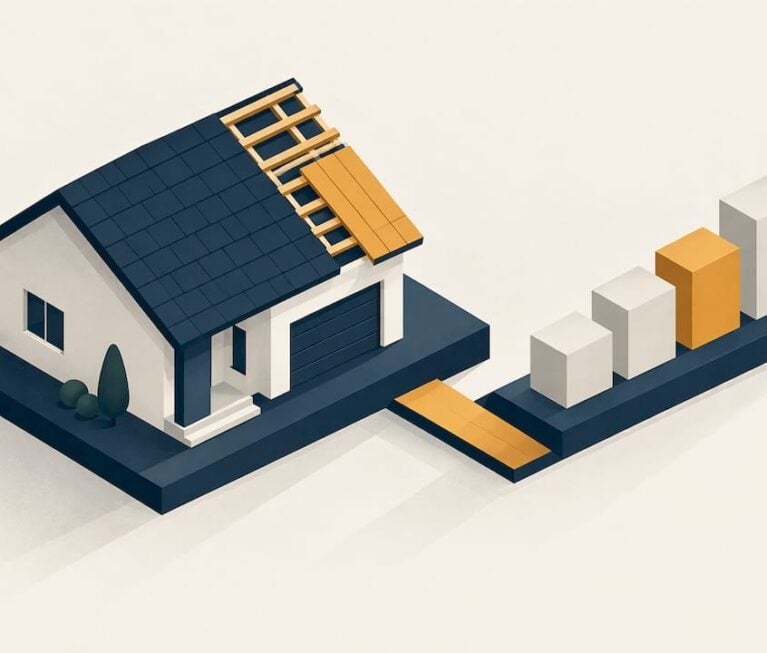
A sagging roof is a structural problem, not a cosmetic one, and it should be assessed by a qualified professional before anything is patched or covered over. The repair depends on what is failing: the roof deck between the rafters, the rafters or trusses themselves, or the connections and walls that hold them. Published U.S. cost guides put the work anywhere from a few hundred dollars to several thousand, and the range is wide because the cause decides the scope.
This guide explains how to tell how serious your sag is, what usually causes it, how each type of sag is repaired, what the costs look like, and how insurance tends to treat it. It also covers what to do in the days before a contractor arrives.
TL;DR
- A dip, bow or sag in the roofline can mean damaged decking, rafters, trusses or connections. Official guidance treats it as a warning sign of possible structural failure.
- If you see a sagging ceiling, new ceiling cracks, doors that suddenly stick, or hear creaking or popping, leave the area and call for help rather than inspecting it yourself.
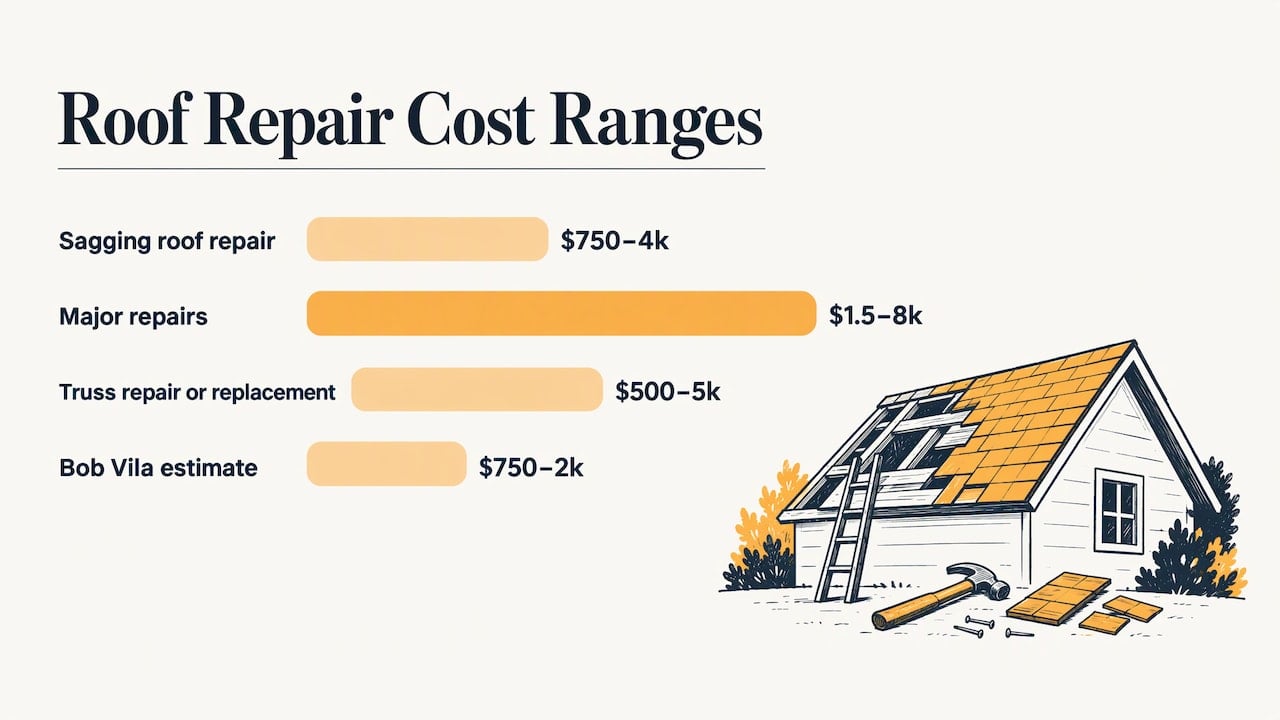
- Published estimates for sagging roof repair run from about $750 to $4,000, with major structural repairs reaching $1,500 to $8,000. Truss work is listed at $500 to $5,000.
- Insurance usually pays for sudden damage from a covered cause, such as wind or the weight of snow and ice, and usually does not pay for wear or deterioration.
- Get a structural assessment first. Repair choices only make sense once the cause is known.
Table of Contents
- How serious is a sagging roof?
- What causes a roof to sag
- How to check safely before the pros arrive
- Repair options by type of sag
- How much does sagging roof repair cost?
- Will insurance cover a sagging roof?
- Why maintenance catches sags early
- What to ask a contractor about a sagging roof
- Our perspective
- Get your sagging roof assessed
- FAQ
- Sources
How serious is a sagging roof?
Treat it as serious until someone qualified says otherwise. Massachusetts’ official roof-collapse guidance lists sagging roofs, severe leaks, bent or rippled supports, cracked or split wood, wall cracks, doors that pop open and unusual noises among the warning signs of a roof under distress. Fairfax County goes further: it advises evacuating and calling emergency services when you notice sagging members, ceiling leaks, new ceiling cracks, or popping and creaking sounds.
A sag is also rarely static. Once a framing member is overloaded or a connection has loosened, the load shifts to neighboring members, which can carry more than they were designed for. That is why a dip that looks mild from the street can still call for prompt attention.
Signs that call for immediate action
Stop and get everyone out of the affected area if you notice any of the following:
- A ceiling that bulges, droops or looks wet and heavy
- New cracks in ceilings or walls, especially near the corners of rooms
- Interior doors or windows that suddenly stick or pop open
- Creaking, popping or cracking from the attic or ceiling
- Bent, rippled or split framing members you can see in the attic
The American Red Cross notes that a sagging ceiling has become wet, heavy and dangerous, and that you should avoid standing beneath it or striking the center of the bulge. Water trapped behind drywall can release all at once.
Signs worth a prompt professional visit
Not every sag is an emergency. A slight, long-standing dip along a ridge or between two rafters, with no leaks or interior cracks, still deserves an inspection, but you have time to schedule it. If you are unsure which category you are in, treat it as the urgent one. Our other guides on recognizing the signs of roof damage and on roof problems that should not be ignored can help you describe what you see when you call.
What causes a roof to sag
The cause determines the repair, so it is worth understanding the main ones.
Moisture and decayed decking
GAF explains that persistent moisture and poor ventilation can decay roof sheathing, and that a sagging ceiling, broken gutters, leaks or missing shingles can point to damaged sheathing. In this case the deck sags between the rafters while the rafters themselves may still be straight. Attic moisture matters here: a homeowner who sees dark staining on the underside of the plywood can read more about attic black spots and plywood to understand how water intrusion and ventilation problems relate to decking.
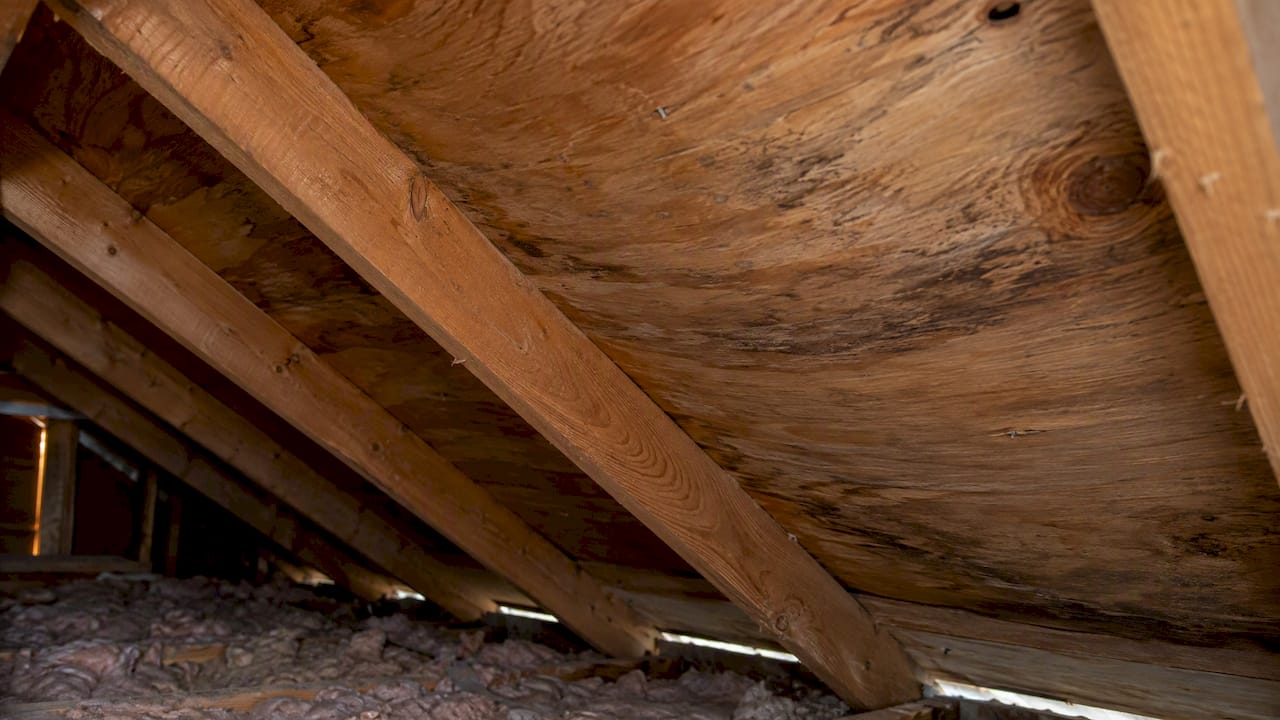
The Disaster-Proof Texas program at UTSA lists waterlogging, rot, insect infestation, buckling, bowing, swelling, loose connections and corroded components as common forms of roof-structure damage. In Florida’s humid climate, and in Missouri homes with poor attic airflow, moisture is a frequent contributor.
Undersized or overloaded framing
W.D. Hill Engineering attributes roof sag to undersized supports and misaligned load paths. It also explains that missing or incorrectly arranged rafter ties can let the roof’s outward thrust push walls apart and lower the ridge. This is a different problem from a rotten deck, and a new layer of shingles will not touch it.
Extra weight can add to the problem. Bob Vila’s guide lists age, water damage, excess weight, design flaws, undersized or poor-quality materials and faulty installation among the causes of sagging. Heavy roofing layered over old roofing, stored materials in the attic, or accumulated debris and standing water on a flat commercial roof can all add load.
Rafters versus sheathing
Inspectapedia draws a useful line between sagging sheathing between rafters and sagging rafters. Sheathing may sag because of rot, delamination, or thin or unsuitable material. Rafters may sag because they are undersized or have been attacked by insects or rot. A good inspection works out which one you have before any quote is written.
Storm damage
Both of our service regions see storms that stress roofs: hurricane-force winds in Florida and severe storms in Missouri. Wind can lift decking and loosen connections, and storm leaks can saturate framing that then deteriorates over the following months. If your sag appeared after a storm, tell your contractor and your insurer when you first noticed it.
How to check safely before the pros arrive
You do not need to climb anything. From the ground, sight along the ridge and the eaves, ideally from a few spots around the house, in daylight. Look for waves, dips, a ridge that is no longer straight, or gaps where the roofline meets walls.
Inside, look at ceilings for stains, bulges and new cracks. If you can reach the attic safely without stepping on the ceiling below, look for:
- Water stains or dark patches on the underside of the decking
- Rafters or truss members that are bowed, cracked or split
- Connections that look loose or have separated
- Daylight where there should be none
If anything in the attic looks cracked, wet or deformed, skip the attic and call. Take photos from where you can safely stand, and note when you first saw the problem. Those photos help both the contractor and any insurance claim.
Repair options by type of sag
There is no single fix for a sagging roof. The right repair follows the cause.
| Cause | Typical repair approach | Notes |
|---|---|---|
| Rotted or delaminated decking between rafters | Strip roofing over the area, cut out and replace the decking, fix the moisture source, reinstall roofing | Often needs ventilation or leak correction as well |
| Sagging or damaged rafters | Stabilize with supports that reduce the span and transfer load to a bearing wall, or sister new members | Typically needs a qualified contractor, sometimes an engineer |
| Damaged trusses | Engineered repair, such as a connected member beside the damaged one or gusset plates | Evaluate with a structural engineer |
| Spreading walls or missing rafter ties | Restore ties and correct the load path | Structural assessment first |
| Widespread deterioration | Replace decking and roofing system | Replacement may cost less than repeated repairs |
Decking replacement
If the sag is confined to the deck, the work generally involves removing the roofing from the affected area, cutting out the damaged sheathing, and installing new decking before re-roofing. Forbes notes that whether repair is possible depends on the cause and extent of the damage, and that sagging plywood decking is fixed by replacing it. The moisture source has to be found and corrected, or the new deck will fail the same way. The U.S. Department of Energy’s repair guidance advises removing damaged materials and allowing the structure to dry before repair.
Rafter stabilization
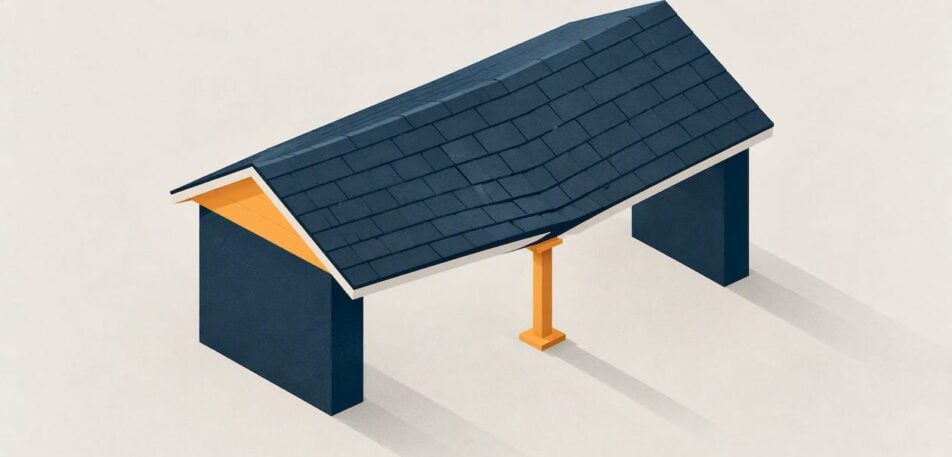
InterNACHI says sagging rafters should be stabilized by a qualified contractor, typically with a purlin system that reduces rafter span and carries the load to a bearing wall. The point is to shorten the distance each rafter has to span unsupported, and to send the load down into a part of the house built to take it.
Truss repair
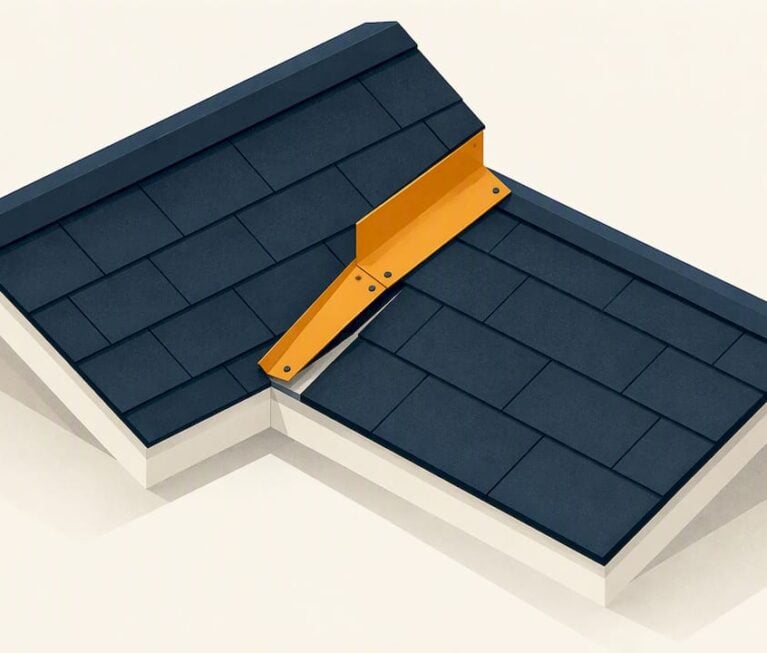
Trusses are engineered as a system. The DOE’s structural guidance says every member contributes to capacity, and removing or cutting one is comparable to cutting through a solid beam. Because of that, it recommends that damaged trusses be evaluated and repaired with a qualified structural engineer. Common engineered repairs include a securely connected member alongside the damaged one, or plywood, OSB or metal gusset plates. This is not a place for improvised lumber.
Temporary bracing
Bracing is a stopgap, not a repair. The DOE guide recommends attic bracing and tie-downs at critical load points. Where the roof is visibly failing, do not enter the attic or load the area. Adding supports to a sagging roof without understanding the load path can push the problem elsewhere, so have a professional decide where and how to brace. Our roof repair team can assess the framing and recommend temporary measures if the situation is urgent.
Repair or replace?
Repair makes sense when the damage is local: a section of decking, a few rafters, one failed connection. Replacement becomes the sensible option when decay is widespread, the roofing system is near the end of its life, or the framing needs enough work that opening the whole roof is more efficient. A contractor should be able to explain why, and show you photos of what they found. If you are weighing the two, our guide to the signs a roof needs repair or replacement walks through the decision.
How much does sagging roof repair cost?
Published estimates vary because the problem varies. Here is what the major national guides report:
| Item | Published range | Source |
|---|---|---|
| Sagging roof repair | $750 to $4,000 | Forbes Home |
| Major repairs, including sagging | $1,500 to $8,000 | Forbes Home |
| Roof truss repair or replacement | $500 to $5,000 | Forbes Home |
| Sagging roof repair, one estimate | $750 to $2,000, roughly one to two weeks | Bob Vila |
Treat these as orientation, not a quote. Your own number depends on roof size and type, extent of damage, pitch, location and material, which are the factors Forbes names. For truss work, it adds roof age, visible damage, leaks, rot, and whether repair or full replacement is required.
Two cautions help when you compare bids. First, a low number that does not mention the cause of the sag probably does not address it. Second, structural work can uncover more once the roofing comes off, so ask how the contractor handles additional findings and how they document them before you sign. GenX Roofing does not publish fixed prices, because the scope of a sagging roof can only be set after inspection. We aim to give honest, accurate estimates that spell out what is included.
Will insurance cover a sagging roof?
It depends on the cause and on your policy. Maryland’s insurance advisory explains that homeowners policies typically cover sudden, accidental losses from specified perils such as fire, wind, hail, or the weight of ice and snow, but generally do not cover maintenance, wear or deterioration. It also warns that when a covered peril damages a roof already worn down, the policy may pay only part of the claim, or none of it. Partial damage may be limited to the damaged portion.
In practical terms:
- A sag that appeared right after a storm or heavy snow load has a better chance of being a covered event than one that developed slowly from rot.
- Photos taken before and after, and dated records of past repairs and maintenance, strengthen a claim.
- Read your policy, then ask your agent. The policy controls, and rules vary by state and insurer.
That Maryland document is one state’s advisory, so check what applies where you live. In Florida and Missouri, ask your insurer about storm deductibles and any roof-age provisions before the inspection.
Why maintenance catches sags early
Most sags start as small problems: a slow leak around a vent, a clogged gutter that backs water under the shingles, a vent that no longer moves air. Regular inspection finds them while the fix is small. Fascia and soffit repairs, flashing and sealant work, gutter cleaning, and ventilation upgrades are the kind of work that keeps decking dry. If your roof is older, our guide on how to recognize when your roof needs maintenance is a good starting checklist.
Property managers and commercial owners face the same pattern on a larger scale, especially where water ponds on low-slope roofs. Scheduled inspections and a commercial preventative maintenance plan turn surprises into planned work.
What to ask a contractor about a sagging roof
Before you hire anyone, ask these questions and expect clear answers:
- What do you think is causing the sag, and what did you see that tells you so?
- Will an engineer be involved, and who pays for that?
- Is the repair temporary or permanent, and what does the written scope include?
- How will you handle hidden damage found after the roofing is removed?
- Are you licensed and insured for work in this state, and can I see proof?
- Will you fix the moisture or ventilation source as part of the work?
Our guide on how to find the best roof repair contractor covers more of what to look for.
Our perspective
We see a pattern with sagging roofs: owners wait because the roof still keeps the rain out. The dip looks like a cosmetic flaw, and the repair sounds expensive. Then a storm season arrives, and a sag that was a modest decking job becomes a framing job.
Our approach is to find the cause first. A sagging roof in a Florida home, where humidity and hurricane winds work on the structure, is not the same problem as one in a Missouri home carrying storm and seasonal loads. We build and repair roofs with those conditions in mind, and we explain what we find in plain terms, with an honest estimate, before work begins.
We would rather tell you that a section of decking needs replacing than sell you a full roof you do not need, and we would rather tell you the framing needs an engineer than guess. If the best answer is replacement, we will say why. Our crews are licensed and insured, and we handle both residential and commercial roofs, so we can scope the job at the level of detail your property needs.
the author
Get your sagging roof assessed
If you have noticed a dip, a bulge or any of the warning signs above, we can inspect the roof, identify what is causing the sag, and give you a clear scope. We repair and replace roofs for homes and commercial buildings in Florida and Missouri, including storm and wind damage restoration, decking and shingle, tile or metal panel replacement, flashing and sealant repair, and ventilation upgrades.
See our roofing services or visit genxroofing.com to request an inspection. If the ceiling is bulging or you hear cracking, leave the area first and call emergency services.
FAQ
Is it expensive to fix a sagging roof?
It can range from modest to significant. Forbes Home lists sagging roof repair at $750 to $4,000, and says major repairs generally cost $1,500 to $8,000. The final figure depends on roof size, damage extent, pitch and materials, so get a written estimate after an inspection.
How much does it cost to repair roof trusses?
Forbes Home lists truss repair or replacement at $500 to $5,000. The spread reflects roof age, visible damage, rot, leaks and whether repair or full replacement is needed. Because trusses are structural, an engineer’s evaluation is often part of the process.
Can I fix a sagging roof myself?
We do not recommend it. The repair difficulty and safety risks go beyond ordinary shingle maintenance, and Bob Vila’s guidance recommends professional assessment of a sag. Working on or under a compromised roof can be dangerous, so have a qualified roofer or engineer evaluate it first.
Will insurance cover a sagging roof?
Possibly, if a covered event such as wind, hail, or snow and ice weight caused it. Policies generally exclude wear and deterioration, and partial coverage is common when a worn roof is damaged. Check your policy and talk to your agent before repairs begin.
How serious is a sagging roof?
Potentially very serious. Official guidance lists sagging roofs, ceiling cracks and creaking sounds as signs of possible collapse risk. If you see a bulging ceiling, new cracks or hear noises, leave the area and call for help.
Sources
- Roof Collapse and Snow Removal Safety Information, Mass.gov
- Snow and Roof Damage, Fairfax County
- Checking Your Home’s Structure, American Red Cross
- How to Identify Roof Damage, GAF
- Roof Structure Resilience Treatments and Priorities, Disaster-Proof Texas
- Roof Sag: What Is It, and What Causes It?, W.D. Hill Engineering
- Sagging Roof / Rafter Repair, Inspectapedia
- How To Fix a Sagging Roof, Bob Vila
- Should I Repair Or Replace My Roof?, Forbes Home
- Repairing Roofs and Ceilings, U.S. Department of Energy
- Structural Considerations for Solar Installers, U.S. Department of Energy
- Mastering Roof Inspections: Roof Framing, InterNACHI
- How Much Does Roof Repair Cost?, Forbes Home
- Everything You Need To Know About Roofing Prices, Forbes Home
- Does homeowners insurance pay for the replacement of your roof?, Maryland Insurance Administration
- Attic Black Spots: The 10 Square Foot Rule
Recommended
- Roof Flashing Repair: Causes, Costs and When to Replace
- Roof Repair
- Find the Best Roof Repair Contractor for Your Home
- Understanding Roof Repair Costs in Tampa Bay for Homeowners