 Post by
Roof leak detection means tracing water from where you see it to where it actually enters the roof. The two spots are often far apart. The reliable approach is to start inside at the stain or attic, work upslope, check the usual weak points (flashing, vents, valleys, chimneys), and confirm the water path before anyone repairs anything. If you cannot reach the area safely, a professional inspection is the right next step.
This guide covers how to do that, which professional methods exist, why flashing is the most common culprit, how pricing is shaped, and what to do about insurance.
TL;DR
- The stain on your ceiling rarely sits under the hole. Water travels along framing, decking and insulation before it shows up.
- Start in the attic or at the stain, then trace upslope. Check flashing, vents, chimneys, valleys and gutters first.
- Confirm the water path before repairing. Repairing a guess is how leaks come back.
- Professional methods (infrared, moisture metering, electronic testing, controlled water tests) suit different roof types and conditions.
- Report storm-related leaks to your insurer promptly. Wear-related leaks are typically excluded.
Table of Contents
- Signs that water is getting in
- Why the stain is not the leak
- How to find a roof leak step by step
- Roof flashing: the usual suspect
- How professionals detect leaks
- What affects the cost of leak detection and flashing repair
- Perspective
- What to do right after you find a leak
- Why an early inspection and regular maintenance pay off
- Have us find and fix the leak
- FAQ
- Sources
Signs that water is getting in
Some leaks announce themselves with dripping. Many do not. This Old House lists ceiling stains, peeling paint, blistering drywall, puddles in the attic, dripping sounds, musty odors and mold as the usual warning signs.
The same source notes that condensation, plumbing and HVAC leaks can mimic a roof leak. Before you assume the roof is at fault, rule out the other sources. A bathroom supply line, a drain pan or a condensate line can leave a ceiling stain that looks identical. If the stain appears in dry weather, read about AC water leak causes and check nearby plumbing before climbing anywhere.
If the stain grows or darkens after rain, the roof moves up the list. Our own article on why you should never ignore a small roof leak explains how a minor spot can become a bigger repair, and our guide to the seven signs of roofing leaks and damage covers the visual cues in more detail.
Why the stain is not the leak
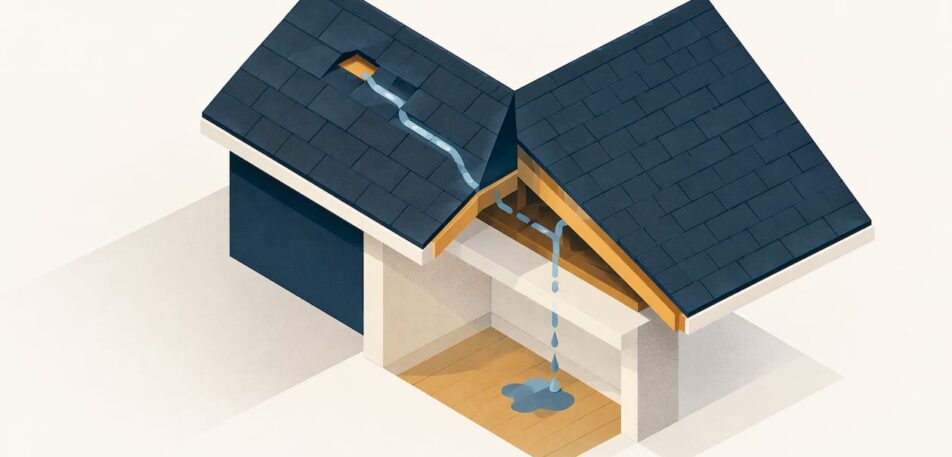
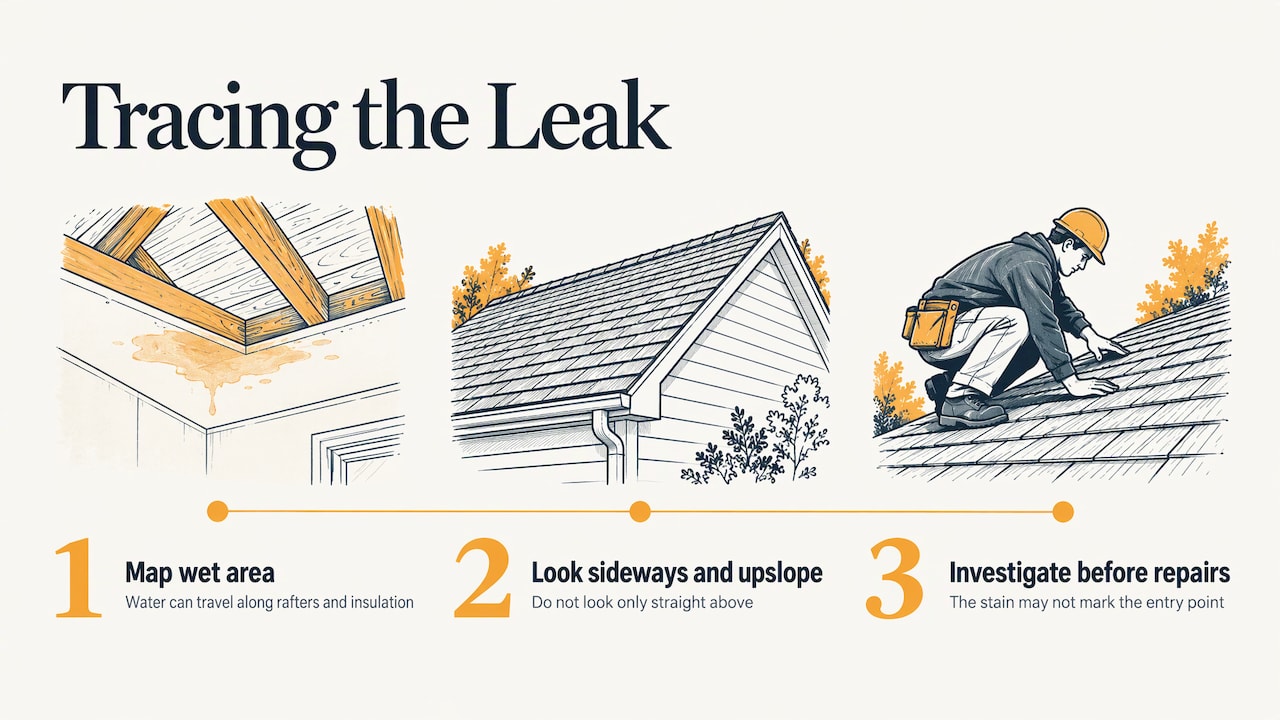
The most common mistake in roof leak detection is repairing the roof directly above the stain. The University of Wisconsin–Madison Extension guide warns that leaks are rarely directly above the ceiling spot. Water follows rafters, sheathing and insulation, then drops where it finds a gap.
The Western States Roofing Contractors Association made the same point in an August 2026 technical bulletin: in low-slope roof assemblies, interior water often travels considerable distances, so the visible stain commonly does not identify the entry point. The bulletin recommends a systematic investigation before repairs.
In practice that means you map the wet area, then look sideways and upslope from it, not just straight up.
How to find a roof leak step by step
1. Start in the attic, if you can reach it safely
Bob Vila advises entering an attic with care: step on joists or proper flooring, never on ceiling material, carry a flashlight and follow damaged insulation back toward its source. Look at every penetration: vent pipes, plumbing stacks, skylights, chimneys and any nail holes that look dark or wet.
If you find a drip trail, the Wisconsin guide suggests marking the spot by pushing a nail, straw or wire up through the hole, so you can locate it from outside.
2. Check from the ground first
Before going on the roof, use binoculars. The same extension guide recommends binoculars before roof access. From the ground you can often spot missing or lifted shingles, displaced flashing, debris in valleys or sagging gutters. Walking a wet, steep or high roof is a real fall risk, and it can also damage the roofing material.
3. Inspect the likely entry points
GAF’s homeowner checklist suggests moving from the attic and ceilings to the gutters, eaves, fascia and roof surface, looking for missing or damaged shingles, open seams, blocked vents, exposed fasteners and inadequate flashing. A practical order:
- Flashing at chimneys, walls, skylights and dormers
- Plumbing vents and exhaust penetrations
- Valleys and roof-to-wall transitions
- Exposed or backed-out fasteners
- Gutters, downspouts, fascia and soffits
- Shingle, tile or metal panel condition near the area you mapped
4. No attic access? Work from the ceiling and the exterior
Many homes, especially those with vaulted ceilings or flat roofs, have no accessible attic. In that case, photograph and mark the stain’s edges, note when it grows (during rain, after wind-driven rain or after snowmelt), and inspect the exterior upslope and sideways from that area using binoculars. Consider whether the water could be running along a wall or from a roof-to-wall junction. If the exterior shows nothing obvious, that is the point to bring in a professional with moisture-detection equipment rather than cutting into drywall at random.
5. Know when to stop
Stop and call a roofer if the roof is steep, wet, multi-story or hard to reach, or if you see signs of structural trouble such as sagging decking. A 2026 temporary-repair guide recommends professional help for steep, wet, multi-storey or structurally suspect roofs.
Roof flashing: the usual suspect
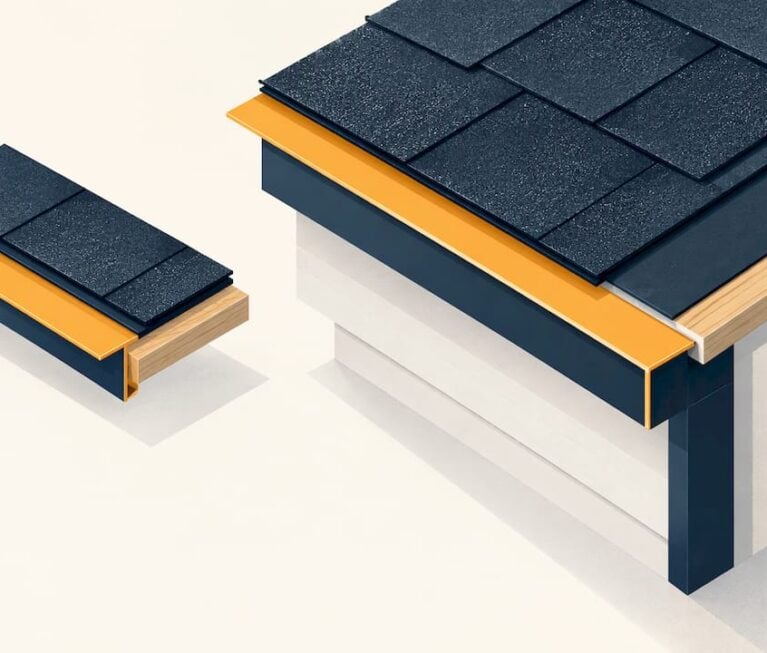
Flashing is the thin metal (or sometimes membrane) that seals the joints where a roof meets something else: a chimney, wall, vent pipe, skylight or valley. Because it handles the most water-prone details on the roof, it is where many leaks start.
The Wisconsin Extension guide lists the common causes of flashing leaks: defective or narrow flashing, loose mortar, clogged downspouts or eaves, ice buildup, deterioration, storm damage, faulty construction and holes. It adds that wet spots near chimneys or outside walls may point to defective flashing, and that valleys, dormers and roof junctions deserve a close look for corroded, loose or displaced pieces.
Signs the flashing is the source
- Staining on the ceiling or wall near a chimney, dormer or exterior wall
- Visible rust, bends, gaps or lifted edges in the metal
- Dried, cracked or pulled-away sealant around vents and chimneys
- Water marks in the attic that trace back to a penetration rather than the open roof field
- Leaks that appear mainly in wind-driven rain
How flashing repair works
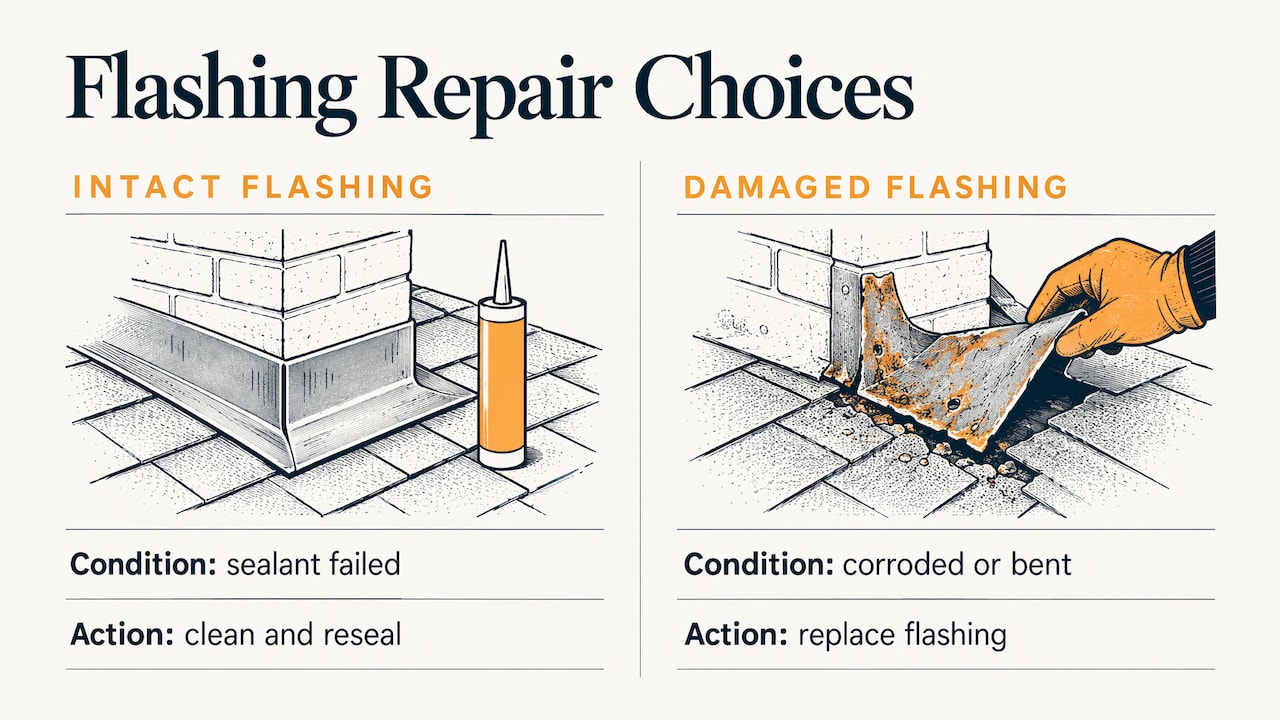
A lasting repair treats the roof as a system. One 2026 repair guide says to verify the water path, then correct the failed flashing, roof covering, fastener or drainage path together, using compatible materials and following manufacturer instructions. It also advises resealing only sound, correctly shaped joints and replacing flashing that is corroded, split or damaged.
A roofing reference makes a similar distinction: intact flashing with failed sealant can be cleaned and resealed, while corroded or bent flashing should be replaced. It also suggests leaving chimney counterflashing and valley flashing to professionals, which matches our experience that these details are rarely a simple caulk-and-go job.
How professionals detect leaks
When visual inspection does not settle it, there are several methods. The right one depends on the roof.
| Method | What it does | Best suited to |
|---|---|---|
| Visual and hose testing | Traces exposed entry points, isolating one area at a time with water | Sloped roofs, flashing and penetrations |
| Moisture metering | Finds wet materials under the surface | Recent leaks, while materials are still wet |
| Infrared (thermal) survey | Shows temperature patterns from wet insulation | Low-slope and commercial roofs, often after sundown |
| Electronic leak detection | Locates breaches in a membrane using electrical potential | Membrane roofs, including under ballast or overburden |
| Flood testing | Shows whether an area holds water | Low-slope roofs that can carry the load |
The differences matter. Anvilfield’s commercial field guide separates hose testing for exposed entry points, flood testing, electronic detection for breaches under overburden, and infrared or moisture surveys for wet insulation rather than exact hole location. An NRCA-hosted leakage-detection study reports that electrical potential methods can position a leak within centimeters when conditions permit, and that method choice should follow the membrane and substrate.
Timing matters too. Inspectapedia notes that moisture meters and infrared work best while materials are wet and can be unreliable after drying, and that meter depth or missing insulation can mislead. That is one reason to call for an inspection soon after a leak appears rather than waiting for the next storm.
Flood testing deserves a caution. The Construction Specifier reports that ASTM D5957 permits water up to 4 inches deep, which adds about 20.76 pounds per square foot, and that NRCA does not recommend flood testing new roof systems to find leak sources because it may not pinpoint the breach. It is better at confirming that water is present than at locating it, and it places a heavy temporary load on the roof.
If you manage a flat or low-slope commercial roof, see our page on commercial roof leak repair for Florida businesses and our commercial roofing services.
What affects the cost of leak detection and flashing repair
We do not publish fixed prices, because the scope of a leak depends on the roof in front of us. What you can know in advance is what moves a quote. The National Roof Certification and Inspection Association (published February 2026) lists these factors for a leak inspection: size and layout, slope and access, material, method, purpose and region.
- Size and layout: more roof planes, dormers and levels take more time.
- Slope and access: steep or fragile surfaces require fall protection.
- Material: tile and slate take longer to work on than asphalt shingle.
- Method: a visual inspection, infrared scan, moisture metering and a controlled water test are different levels of work.
- Purpose: a sale, insurance claim or certification calls for more documentation.
- Region: labor and insurance costs differ by market.
Flashing repair follows the same logic. A short section of resealed or replaced flashing at one vent is a small job. Rebuilding chimney counterflashing, a long valley or a wall junction, with shingles or siding to be removed and reinstalled, is larger. The most useful thing you can do is ask for an estimate that names the failed component, where it is, and how the repair will correct it. If you want a primer on picking a contractor, read our guide to finding the best roof repair contractor.
Perspective
We approach every leak as a diagnosis first and a repair second. With over 20 years in the industry, we have seen how often the stain on a ceiling is far from the actual entry point, and how often a quick patch above the stain simply delays the next call.
Florida and Missouri roofs face different stress. Hurricanes and wind-driven rain test flashing, fasteners and edges in Florida, while Missouri storms add their own wear. That is why our estimates describe what failed, where, and what the repair will correct, and why we explain the plan before work starts.
Flashing, vents, valleys and drainage are not afterthoughts. They are where roofs meet the weather. A repair that treats the shingles, flashing and drainage as one system is the repair most likely to hold, and that is the standard our licensed and insured crews work to.
the author
What to do right after you find a leak
- Protect the interior. Move belongings, place a container under the drip and, if it is safe, relieve water trapped in a bulging ceiling by a small controlled puncture into a bucket. If water is near light fixtures or outlets, stay away and shut off power to that area at the panel.
- Document everything. Take dated photos and video of the stain, the attic and any exterior damage.
- Stop further water entry if you can do so safely. The California Department of Insurance advises homeowners to try to find and stop leaks at the source right away.
- Treat temporary fixes as temporary. The same temporary-repair guide says tarps, tape, sealant and roofing cement are stopgaps that commonly last 30 to 90 days, depending on method, material and exposure.
- Call a roofer for diagnosis and permanent repair. Our emergency leak detection and repair covers active leaks and storm damage.
Does homeowners insurance cover a roof leak?
It depends on the cause. The California Department of Insurance explains that homeowners policies do not cover flood but do cover other water damage, such as rain entering through a hole in the roof caused by wind or another covered event, and that mold from a covered peril may also be covered. Farmers Insurance says leaks from a sudden, covered event such as storm damage or a fallen tree may be covered, while wear and tear, poor maintenance or gradual damage typically are not.
Policies and state rules differ, so read yours and call your insurer promptly. After hail or wind events, our guide to hail damage roof inspection shows what to document.
Why an early inspection and regular maintenance pay off
GAF notes that routine inspections, especially in areas with extreme weather, can help keep exterior damage from becoming interior problems. For homes in Florida and Missouri, a check of flashing, sealant, fasteners and drainage before storm season is the simplest way to catch a weak point while it is still a small repair. Read our overview of when your roof needs maintenance if you are unsure how often to check.
Property managers and business owners often prefer a scheduled plan so inspections happen on a calendar instead of after a complaint. We offer roof inspection and maintenance plans for both residential and commercial properties.
Have us find and fix the leak
GenX Roofing provides leak detection, repair, storm damage restoration, flashing and sealant repair around vents and chimneys, gutter and drainage work, and full roof replacement for homes and commercial buildings in Florida and Missouri. Our crews are licensed and insured, and we aim to give you a clear, honest estimate that explains the source of the leak and the plan to correct it.

If you have an active leak or a stain you cannot explain, contact us through our roof repair services page or start from our roofing services overview. If the roof is near the end of its life, see our roof replacement and installation options.
FAQ
How do I find out where my roof is leaking?
Start at the stain or in the attic, follow the water trail upslope and sideways, and inspect penetrations, flashing, valleys and gutters. Binoculars from the ground let you look at the roof without climbing it. If the source is still unclear, a professional can use moisture metering or infrared while materials are wet.
How can I find a roof leak without attic access?
Mark the edges of the interior stain and note when it grows. Then inspect the exterior upslope and beside that area from the ground, focusing on flashing, vents and roof-to-wall junctions. Without attic access, a professional with moisture-detection tools is safer than opening up ceilings or walking the roof yourself.
Can I repair leaking flashing myself?
Intact flashing with failed sealant can sometimes be cleaned and resealed, but corroded or bent pieces need replacing, and chimney and valley flashing are generally better left to professionals. Working at height on a wet or steep roof is hazardous, so a licensed roofer is the safer choice for most flashing work.
Is a roof leak covered by homeowners insurance?
Often when a sudden, covered event such as wind or a fallen tree causes it. Leaks from wear, poor maintenance or gradual damage typically are not covered. Report the leak to your insurer promptly and keep photos and repair records.
Sources
- How To Find and Fix a Roof Leak, This Old House
- Assessing and Repairing Leaky Roofs, University of Wisconsin–Madison Extension
- Western States Roofing Contractors Association technical bulletin on roof leak investigation
- How to Find a Roof Leak, Bob Vila
- How to Identify Roof Damage and What to Look For, GAF
- Temporary roof repair guide, The Roofing Brief
- How to Repair Roof Flashing, Expertworx
- How to Repair Roof Flashing at Chimneys and Vents, Roofs Wiki
- Roof leak diagnosis and troubleshooting for commercial roofs, Anvilfield
- Leakage Detection Methods for Roof Membranes, NRCA
- Roof Leaks: diagnosis and repair guide, Inspectapedia
- Everything Leaks: Testing roofs, The Construction Specifier
- Roof leak inspection service, NRCIA
- Residential Property Claims Guide, California Department of Insurance
- Does Home Insurance Cover Roof Leaks?, Farmers Insurance
- AC Leaking Water: Quick Fixes and When to Call a Pro
Recommended
- Roof Leak Repair: What You Need to Know
- How to Recognize the Signs of Roof Damage Before It’s Too Late
- Don’t Overlook These 7 Signs of Roofing Leaks and Damage
- Recognize These Common Roofing Problems to Avoid Damage