 Post by
A wind damaged roof needs three things in order: safe documentation, temporary protection from water, and a hands-on inspection by a licensed roofer who can tell you whether the fix is a few shingles, a full slope or more. At GenX Roofing, we handle wind and storm damage restoration for homes and commercial buildings in Florida and Missouri, and this guide explains what happens at each stage so you can make decisions with a clear head.
TL;DR
- Wind damage usually starts at roof edges and corners, and some of it cannot be seen from the ground or in photos.
- Photograph everything, call your insurer promptly, and limit yourself to temporary protection until the adjuster has visited.
- A few blown-off shingles mean a repair. Damage across one side generally means replacing that slope. Widespread damage can justify a new roof.
- Stay off the roof. Roofing associations advise homeowners not to attempt repairs except in extreme circumstances.
- Ask a licensed, insured roofer for a written scope that matches what the insurer sees.
Table of Contents
- Can wind really damage a roof?
- How to tell if wind damaged your roof
- What to do in the first 48 hours
- Repair or replace: how the scope gets decided
- What a proper wind repair involves
- What wind damage repair costs
- Insurance and wind damage claims
- Preventing the next wind loss
- Our perspective on wind damage
- Talk to GenX Roofing about your wind damage
- FAQ
- Sources
Can wind really damage a roof?
Yes, and it takes less than hurricane force. The National Weather Service says tropical-storm winds of 60 to 73 mph can cause partial wall and roof failure in poorly or averagely constructed houses. NOAA describes damaging winds as anything above 50 to 60 mph. Ordinary thunderstorm gusts reach that range often, in Missouri as well as along the Florida coast.
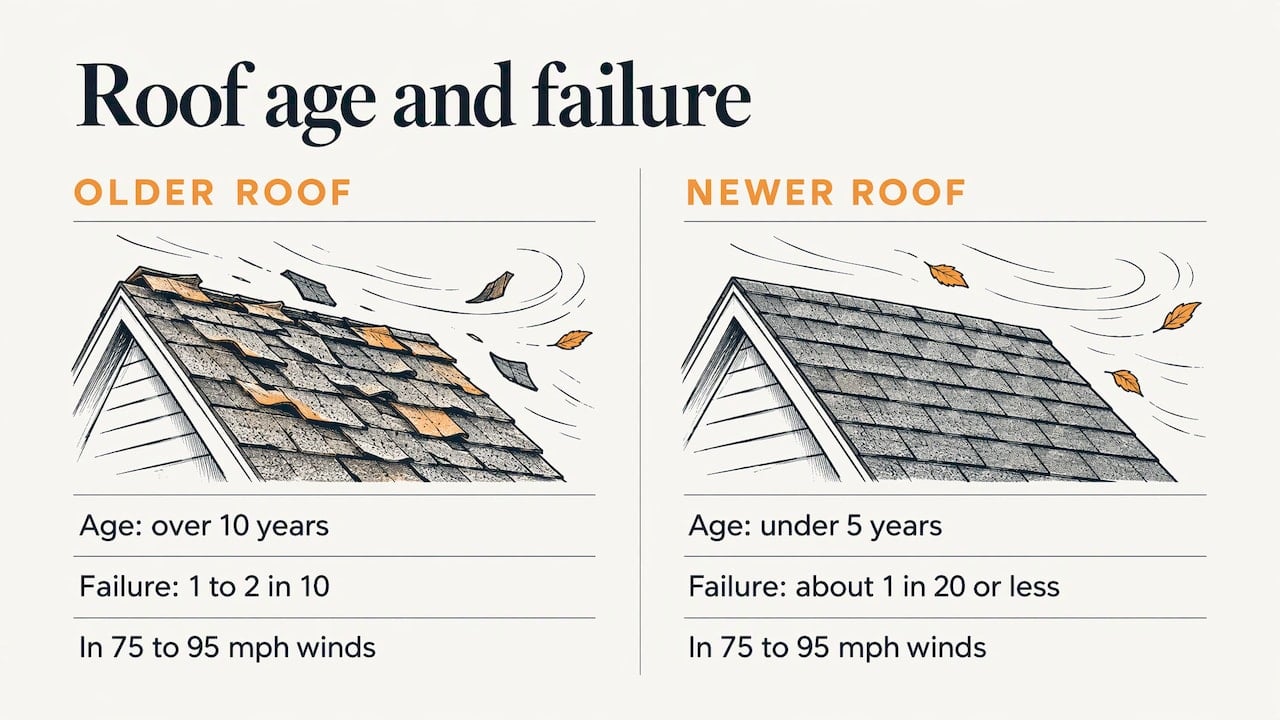
Roof age and rating matter too. Florida’s official Hurricane Retrofit Guide lists asphalt-shingle wind classes from 60 mph for Class A up to 150 mph for Class H. The same guide reports that in 75 to 95 mph winds, older roofs over 10 years old failed at roughly 1 to 2 in 10, while roofs under 5 years failed at about 1 in 20 or less. A roof’s age, its shingle class and how well it was fastened all shape what a storm does to it. Wind ratings matter for other outdoor structures as well, and awning wind speed ratings show how quickly safe limits are exceeded.
How to tell if wind damaged your roof
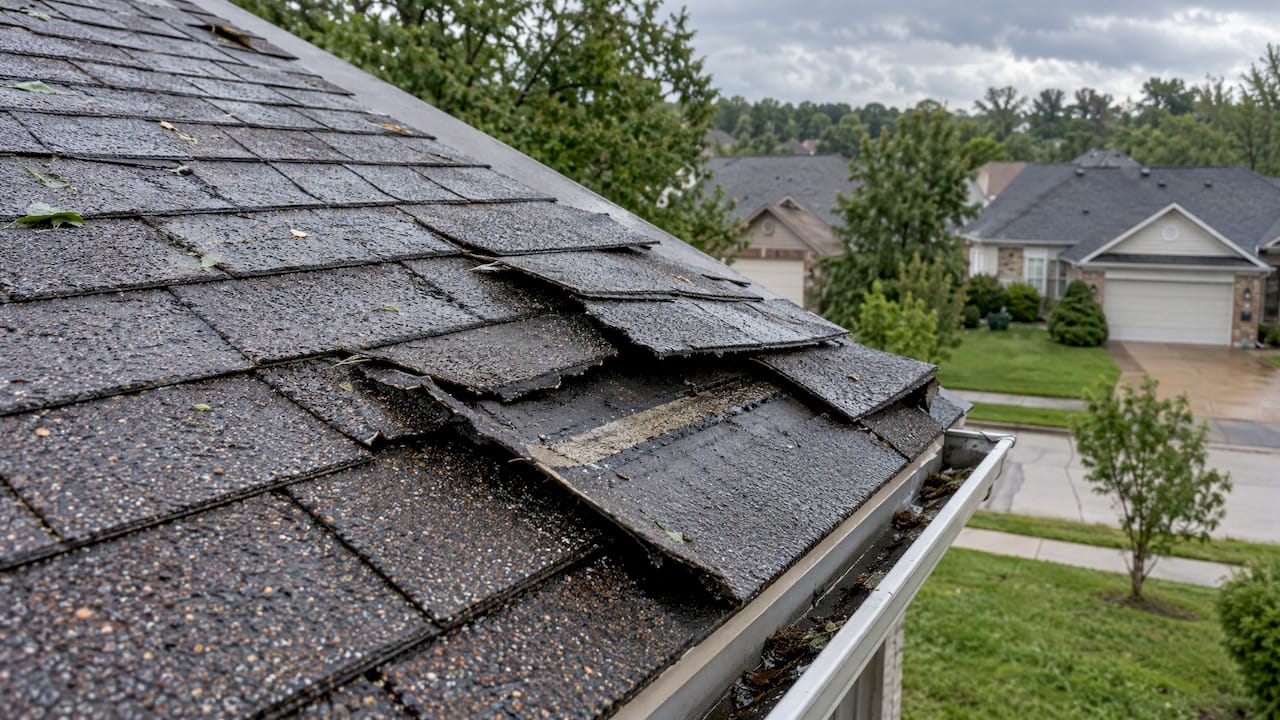
Wind damage often begins where the roof is most exposed. The National Roofing Contractors Association (NRCA) explains that suction lifts loosened materials at the edges, and pressure then drives a peeling effect across the roof. That is why edges, corners, ridges and eaves deserve the closest look.
What you can check from the ground
Walk the property in daylight and look for:
- Missing, cracked or curled shingles, and shingle pieces in the yard
- Bent or detached flashing, the metal strips at chimneys, vents and wall joints
- Loose drip edges, which can be easier to see from the ground than from the roof
- Damaged siding, trim, gutters and downspouts
- Branches, glass or other debris on the roof, since NRCA notes that debris can also clog drains and downspouts
Inside, GAF suggests checking an accessible attic in daylight for sunlight coming through or sagging, and treating ceiling and wall stains as a possible leak. If you see a stain, our roof leak detection page explains how the source is traced.
Damage that looks fine
The hardest damage to catch is the kind that hides. Facility Executive reports that lifted shingles can settle back into place while concealing tears, pulled-through fasteners and broken seals. Those conditions generally call for a close, hands-on inspection, and binoculars or drone photos alone may miss them. A roof that looks intact from the driveway can still have lost its seal strength, which is what keeps shingles down in the next storm.
What to do in the first 48 hours
The order matters because it protects both your home and your claim.
- Stay safe. NRCA advises against climbing a ladder to assess damage in darkness, and says homeowners generally should not attempt roof repairs except in extreme circumstances. If you must be on a ladder at all, wear sturdy footwear, long sleeves and work gloves.
- Document. FEMA says to photograph and video the damage and keep undamaged property separate. Capture wide shots of each slope and close-ups of anything damaged.
- Notify your insurer. FEMA recommends prompt written notice. Ask about coverage, exclusions and your deductible, as the Oregon Division of Financial Regulation also advises.
- Limit further damage. Tarping an opening is a reasonable temporary step. Both FEMA and Oregon’s regulator say to avoid permanent repairs before the adjuster’s visit, and to save every receipt.
- Book a professional assessment. NRCA recommends obtaining a professional roofing assessment and keeping receipts for temporary repairs, which insurers are likely to reimburse.
If water is already coming in, our team handles emergency leak detection and repair. For a longer checklist, see our guide to storm damage roof repair and who to call.
Repair or replace: how the scope gets decided
This is the question that drives cost and insurance conversations. Two sources give a workable rule of thumb.
Oregon’s insurance regulator says a few wind-blown shingles likely mean replacing those shingles, not the whole roof, while damage on one side normally means replacing that slope. The Department of Energy’s repair guide, drawing on the JLC Field Guide, recommends a new roof if more than 10% of the old roof needs repair.
| What the inspection finds | Typical scope |
|---|---|
| A few missing or creased shingles, intact decking | Replace the damaged shingles and reseal lifted tabs |
| Bent flashing or loose drip edge | Replace or refasten the metal and reseal |
| Damage concentrated on the windward slope | Replace that slope |
| Damaged decking under torn-off areas | Replace sheathing, then re-cover |
| More than about 10% of the roof needs work, or old, brittle shingles | Discuss a full replacement |
Age changes the answer. A newer roof with a clean, localized loss is a strong repair candidate. An older roof with several damaged areas often costs more to patch repeatedly than to replace once. Our team walks through this with you on site, using what the inspection actually shows. Our shingle, tile or metal panel replacement work covers all three common roof types.
What a proper wind repair involves
A wind repair done correctly goes beyond stapling a few shingles down. The Department of Energy guide describes the sequence: remove roofing material down to the sheathing in damaged areas, replace localized sheathing with panels of the same thickness, then install a weather-resistant barrier and wind-resistant roofing.
For high-wind repair, the same guide specifies 32/16-rated decking at least 5/8 inch thick, and 8d ring-shank nails spaced 4 inches apart near gable ends and 6 inches elsewhere. It also warns that overdriven or poorly placed nails reduce uplift strength. Those details are why fastening quality, not just the shingle, decides how the repair holds up in the next storm.
In practice, a thorough repair visit covers:
- Replacing damaged shingles, tiles or metal panels
- Resealing lifted tabs where shingles are still flexible and sound
- Repairing flashing and sealant around vents and chimneys
- Fixing fascia and soffit damage, and clearing gutters and drainage
- Checking decking and attic conditions beneath the damaged area
All of these appear in our roof repair services.
What wind damage repair costs
No honest single number fits every wind claim, because the price follows the scope, not the storm. These factors move it most:
- How far the damage spread. A few shingles is a small job. A slope is a different order of work.
- Roof material. Asphalt shingle, tile and metal need different parts and skills.
- Decking and underlayment. Once material comes off, wet or split sheathing has to be replaced.
- Roof pitch and access. Steep or multi-story roofs take more time and safety equipment.
- Local labor and permit requirements. These differ between Florida and Missouri and between counties.
- Emergency work. Tarping and same-day response are priced differently from scheduled repairs.
We do not publish fixed prices, because each roof is different. We provide written estimates after inspection, and we describe the scope line by line so you can compare it with your insurer’s.
Insurance and wind damage claims
Most wind damage to a roof is handled under homeowners or commercial property coverage, so it helps to know a few terms before you call.
- Replacement cost vs. actual cash value. The Texas Department of Insurance explains that replacement-cost policies can pay current repair costs, while actual-cash-value coverage pays less for older or worn roofs.
- Separate wind deductible. The same agency notes wind or hail may carry its own deductible, and insurers do not pay for a new roof simply because it is old.
- Flood policies do not cover roof-entry water. FEMA says the National Flood Insurance Program covers direct flood damage, not wind-driven rain or water entering through a wind-damaged roof.
- Weigh the deductible. Oregon’s regulator says a claim is not automatically beneficial when damage is near or below the deductible, given possible effects on future premiums.
If your adjuster and roofer disagree on the scope, NRCA suggests requesting a joint reinspection. A written estimate that lists the damaged areas and materials gives that conversation something concrete to work from. For policy specifics, your insurer or agent is the authority.
Preventing the next wind loss
Repairs are the right moment to improve the roof, not just restore it.
- Inspect yearly and after high-wind events. Florida’s guide recommends checking shingles at least yearly for aging and weakness, and FEMA’s wind-resistant roofing advisory recommends annual inspections and one after every high-wind event, including fastener corrosion, loose trim and sealing cracks.
- Reseal loose tabs early. If shingles are still flexible, resealing may help delay reroofing, per Florida’s guide.
- Choose higher-rated materials at replacement. Higher wind-class shingles are available when installing a new roof, and our roof upgrades include impact-resistant shingles and metal roofing.
- Remove, don’t overlay. Florida’s reroofing guidance says removing old shingles permits replacing damaged sheathing, stronger re-nailing and better underlayment.
- Strengthen the structure. FEMA lists adequate decking, more fasteners and sound roof-to-wall connections as the basis for a stronger roof.
For property managers and business owners, a scheduled plan turns post-storm inspections into routine. We offer commercial preventative maintenance plans alongside commercial roof replacement.
Our perspective on wind damage
Wind damage is a scope question first and a price question second. The roofs that cause the most frustration are the ones where a quick patch covered the visible problem and left the lifted seals, weak fasteners or wet decking underneath.
We build our approach around Florida’s hurricanes and Missouri’s storms, and around honest, accurate estimates. That means telling you what the inspection shows, what the repair involves and whether the roof is a repair candidate or a replacement candidate, with clear communication throughout the project.
Our crews are licensed and insured, and we work on both residential roofs and operating commercial sites, so a repair is planned around how the building is actually used. When we repair, we aim to leave the roof more storm-ready than we found it.
the author
Talk to GenX Roofing about your wind damage
If wind has damaged your roof, our team provides storm and wind damage roof restoration, emergency leak detection and repair, and full replacement when that is the right call, for homes and commercial properties in Florida and Missouri. We are licensed and insured, with over 20 years of industry experience. Start with our roof repair services or reach us through our website.
FAQ
Can 60 mph winds damage a roof?
Yes. The National Weather Service says winds of 60 to 73 mph can cause partial roof failure in poorly or averagely constructed houses. Older roofs and weakly fastened shingles are the most vulnerable, so an inspection after any strong storm is sensible.
Should I repair wind damage myself?
No. NRCA advises homeowners generally not to attempt roof repairs except in extreme circumstances, because working on a storm-damaged roof is hazardous. Temporary protection such as a tarp, installed safely, limits further water damage until a licensed roofer can assess the roof.
Does homeowners insurance cover wind damaged roof repair?
Often yes, subject to your deductible and policy terms. Wind or hail may carry a separate deductible, and actual-cash-value policies pay less on older roofs. Flood policies do not cover water entering through a wind-damaged roof. Contact your insurer promptly and keep your photos and receipts.
Will I need a whole new roof after wind damage?
Not necessarily. A few blown-off shingles usually means replacing those shingles, and damage on one side usually means replacing that slope. A full replacement is more likely when more than about 10% of the roof needs repair or the roof is already worn.
Sources
- NWS: Hurricane Wind Threats and Impacts
- HUD: Designing for Natural Hazards, Wind
- Florida Hurricane Retrofit Guide: Shingle Roofs
- Florida Hurricane Retrofit Guide: Re-Roofing
- NRCA: Roof Repair After Strong Winds
- InterNACHI: Wind Damage Inspections, Part 6
- GAF: Storm Damage Roof Repairs
- Facility Executive: Drones for Roof Inspections
- FEMA: Flood and storm damage guidance
- Oregon Division of Financial Regulation: Storm damage
- U.S. Department of Energy: Repairing Roofs and Ceilings
- Texas Department of Insurance: Your roof and insurance
- FEMA: Code-Based Wind-Resistant Roofing for Homes
- Awning wind speed ratings
Recommended
- Storm Damage Roof Repair: What to Do and Who to Call
- Hail Damage Roof Inspection: What to Check and Who to Call
- Modified Bitumen Roof Repair: Methods, Timing and Pro Help