 Post by
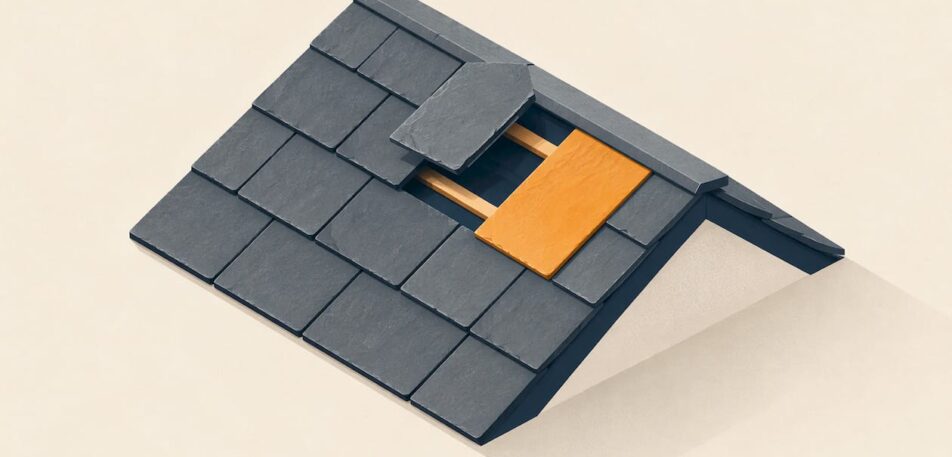
A slate roof can last well over a century, but only when the small failures are caught early and repaired the right way. Most slate problems start with a single slipped, cracked or missing slate. Left alone, that gap lets water reach the sheathing and framing underneath. This guide shows how to recognize each type of damage, what a correct repair looks like, and when repair stops making sense. It also explains why a careful inspection before any work is the step that saves you the most money.
TL;DR
- Broken, cracked and missing slates should be repaired promptly. Water that gets in damages interiors, sheathing and framing, according to the National Park Service.
- Many “slate leaks” are not caused by the slates. Gutters, valleys and flashings are more likely sources, so the cause has to be found before anything is replaced.
- If fewer than about 20% of the slates are damaged or missing and the roof is otherwise sound, repair is usually the right path. Above that, a larger re-slate is likely.
- Sealant and mastic are not a lasting slate repair. A proper fix uses nails and metal flashing that suit the slate.
- Slate is slippery and brittle underfoot. Spot problems from the ground and leave the work to a crew set up to do it safely.
Table of Contents
- How to tell what is wrong with your slate roof
- Finding the real source of a leak
- What a proper slate repair involves
- Repair or re-slate: where the line falls
- Keeping people off the roof
- Moss, gutters and maintenance that extend life
- Our perspective
- Where we come in
- FAQ
- Sources
How to tell what is wrong with your slate roof
Start from the ground. The National Park Service recommends surveying a slate roof from the ground with binoculars or from a cherry picker (a lift with a bucket). Walking on the roof is itself a cause of damage.
Run your eye along each course (horizontal row) from ridge to eaves. The Institute of Historic Building Conservation suggests looking for damaged, missing or slipped slates, plant growth and changes in color. It also notes that not every color change or small crack means a roof is in poor repair, because some aging is normal.
Common types of damage
| What you see | What it usually means |
|---|---|
| A slate sitting lower than its neighbors | The fixing has failed and the slate has slid down |
| A row of slates sitting unevenly | Corroding nails, often called “nail sickness” |
| A cracked or broken slate | Impact from a limb, foot traffic, or snow and ice load |
| A visible gap in a course | A missing slate, which exposes the felt or sheathing below |
| Flaking or thinning around nail holes | The slate itself is breaking down |
| Stains on a ceiling or wall | Water is getting in, though not necessarily right above the stain |
The National Slate Association lists foot traffic, fallen tree limbs, heavy snow and ice, and stress cracks from quarrying or installation as reasons individual slates are removed and replaced. In Missouri, storms and falling limbs are the likely culprits. In Florida, high winds loosen slates and drive rain under them.
Why nail sickness matters most
Nails and the timbers that hold them usually wear out before the slate does. The Society for the Protection of Ancient Buildings says corroding nails cause slates to slip or split. That is why one slipped slate is sometimes a warning rather than a one-off. If slates are slipping in several different places, the problem is probably the fixings across the roof, not bad luck in one spot.
Finding the real source of a leak
Slate itself is dense and waterproof. When a slate roof leaks, the cause is often somewhere else. The National Park Service notes that gutters, valleys and flashings are more likely leak sources than the slates. It also warns of “false leaks”, where condensation in the attic is mistaken for a roof leak.
Water also travels. Along rafters and sheathing, it can run a long way from the opening before it shows up as a stain. A stain on a ceiling does not tell you where the roof is open. If you want a feel for how leak tracing works inside the house, these tests for finding a ceiling leak show how to separate a plumbing source from water coming through the roof.
For the roof itself, a proper diagnosis covers:
- The slates in the area above the stain and uphill from it.
- Flashing around chimneys, vents, skylights and wall junctions.
- Valleys and gutters, where debris and corrosion cause overflow.
- The attic, ideally during or just after rain, to see where moisture first appears.
Our roof leak detection guide walks through how that process works and what happens after the source is found.
What a proper slate repair involves
You do not need to do this work yourself, but knowing what a correct repair looks like lets you judge any estimate. Here is the standard method, as described by national preservation and trade bodies.
Removing the damaged slate
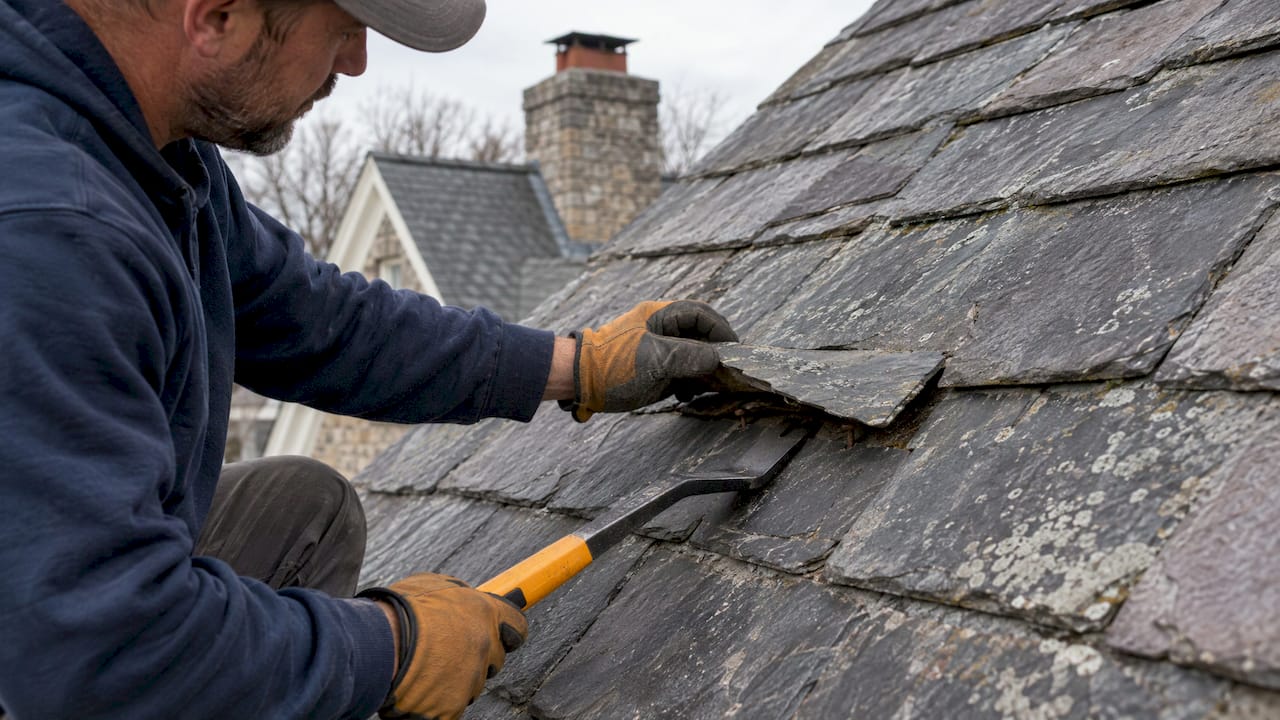
A damaged slate cannot simply be pulled out. It is held by nails hidden under the slates above. The National Slate Association describes using a slate ripper, a long flat tool that slides under the broken slate, hooks the nail, and either pulls it or cuts it with a hammer strike. Cutting the nail shank leaves the surrounding slates undisturbed.
Fixing the replacement
The new slate is slid into place and nailed through the vertical joint between the slates in the course above. The National Park Service places the nail about 1 inch below the tail of the slate two courses above. A copper bib, roughly 3 inches wide by 8 inches long, is then slid under the joint above to cover the nail hole.
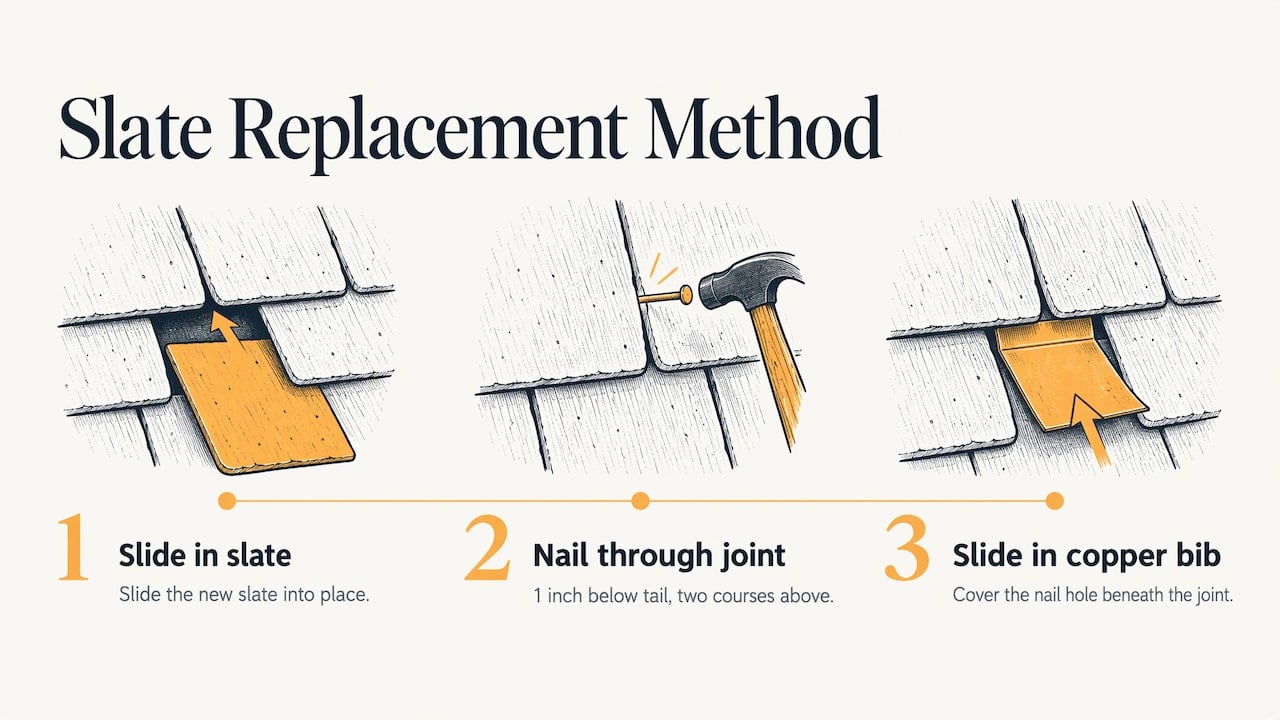
The Slate Roofing Contractors Association’s repair guidelines call for copper or stainless-steel smooth-shank nails and a copper bib flashing of at least 16 ounces, at least 4 inches wide and 6 inches long. Where a nail cannot be used, Cadw, the Welsh heritage service, describes a tingle. This is a thin strip of copper, lead or galvanized steel nailed to the batten and bent over the bottom edge of the new slate to hold it. Proprietary clips are a more discreet option on battened roofs.
Matching size and material
Size matters. Queensland’s heritage technical note warns that wrongly sized replacement slates can lift the surrounding slates and leave the roof no longer watertight. Replacement slates should match the originals in size and character.
Fasteners that last
Galvanized steel nails rust and can stain slate. The National Slate Association says copper, lead-coated copper and stainless steel are used to match or exceed the service life of the slate. A repair that uses the wrong nail brings back the same failure in a few years.
What not to use
Caulk, roofing cement and mastic can look like a quick answer. The National Park Service states that mastic and sealants are not a viable repair because they harden, crack and let water in. They also make later repairs harder and can accelerate corrosion of metal flashings. The SPAB likewise advises against foam or bituminous treatments, because they prevent inspection and reduce ventilation, which raises the risk of timber decay.
Repair or re-slate: where the line falls
The cost question comes down to how widespread the damage is.
- Under about 20% damaged or missing, roof otherwise sound: the National Park Service says the roof should be evaluated for repair rather than replacement.
- Roughly 20 to 25% or more: the IHBC says a full strip and re-slate is likely. The SPAB similarly says re-slating is typically considered once about one-fifth of the slates have been renewed.
Here is a worked example. Say a roof has 1,000 slates and 120 are cracked or missing after a storm. That is 12%, so a targeted repair with proper nails and bibs is a sensible plan. If 300 are affected, you are at 30%, and spending on patches may only delay a bigger job.
The pattern matters as much as the count. An isolated defect, such as one limb strike, is a small repair. Slates slipping in several places suggest a general fixing failure. In that case, repairing one slate at a time is only a stopgap, because the nails and slates have aged together. Keeping dated photos taken from the ground shows whether a roof is losing slates slowly or quickly, and it gives any contractor a clear history to work from.
What drives the price
We do not quote figures without seeing the roof. Slate repair estimates depend on:
- How many slates and flashings need work.
- Roof pitch and height, which control how the crew gets safe access.
- Whether matching slates are available.
- Whether flashing, valleys, gutters or fascia are involved.
- Whether the decking or framing beneath has been wet.
Compare written estimates on scope, not just the bottom line. A good estimate says what is being replaced, what fasteners and flashing will be used, and how the leak source was confirmed.
Keeping people off the roof
Slate is brittle and can be slick. DIY Guides advises that homeowners should not climb onto a slated roof, because slates slide and break under weight and battens are not built to be walked on. Use binoculars and a zoom camera instead.
Where a crew does have to be on the roof, the National Park Service says to use ladders hooked over the ridge, wear soft-soled shoes, and step on the lower-middle of an exposed slate. A cracked slate from a careless step is one of the main reasons repairs turn into bigger repairs.
Moss, gutters and maintenance that extend life
Well-maintained slate can last 150 years or more, according to the IHBC. Maintenance is what gets it there.
- Annual survey from the ground. The National Park Service advises annual surveys, gutter cleaning at least twice in fall and once in early spring, and professional inspections every five to seven years.
- Flashing care. The SPAB advises checking the roof twice a year and reinstating slipped or missing slates before timbers or plaster ceilings are harmed.
- Moss and ivy. The IHBC says a stiff nylon brush with warm water and a little detergent may be enough where access is easy, and that ivy should be cut near the root, left to wither, then gently pulled free. On a steep or high slate roof, moss removal is a job to schedule alongside an inspection, since the surface is the hazard.
For more on routines, see our guides on recognizing when your roof needs maintenance and essential roof maintenance practices.
Our perspective
Most roof trouble we are called to starts as something small that was never traced to its cause. A slipped slate, a stained ceiling, a gutter that overflows in every storm. Each is easy to fix once someone has looked properly, and expensive once water has been in the framing for a season.
That is why we put the inspection first. We are licensed and insured, we have more than 20 years in the trade, and we work in two very different climates: Florida’s hurricanes and Missouri’s storms. Both punish fixings, flashing and gutters, which are the parts that fail before the roof covering does.
We believe an estimate should be honest and accurate, and that communication should continue through the whole project. For you, that means a clear explanation of what is damaged, what it will take to repair, and whether repair or replacement is the better use of your budget.
Our repair work covers leak detection, storm and wind damage restoration, flashing and sealant repair around vents and chimneys, gutter and drainage work, and fascia and soffit repairs. For homes and commercial properties alike, we would rather see the roof early than late.
the author
Where we come in
If you have found slipped or missing slates, a stain you cannot explain, or storm damage on a Florida or Missouri property, our team handles roof repair for residential and commercial clients. That includes emergency leak detection and repair, storm and wind damage restoration, and flashing and sealant repair around vents and chimneys.

We also offer roof inspection and maintenance plans, and commercial preventative maintenance plans for property managers who want a consistent schedule. Start on our roofing services page or go straight to roof repair to request an inspection and written estimate.
FAQ
How long do slate roofs last?
A well-maintained slate roof can last 150 years or more, according to the IHBC. In practice, the fixings and flashing usually wear out before the slate. Regular inspection and timely repair of the nails, flashing and gutters is what lets the slate reach that age.
How do you fix a slipped slate?
The damaged slate is removed by cutting or pulling its nails with a slate ripper. A matching slate is slid in, fixed with a copper or stainless-steel nail, and covered by a copper bib or held with a metal tingle. A nail hole should never be left to sealant alone. Because the work is done on brittle, steep surfaces, it is best handled by a trained roofing crew.
Can I fix slate roof leaks with sealant?
No. The National Park Service states that mastic and sealants harden, crack and let water in. A lasting repair replaces or re-secures the slate with proper fasteners and flashing, and confirms whether a gutter, valley or flashing is the real source.
When is it better to replace the whole slate roof?
When about 20 to 25% or more of the slates are damaged or missing, a full re-slate becomes the more likely answer. The same applies when slates are slipping across the roof because the nails are failing. An inspection and a written estimate show which side of that line your roof is on.
Sources
- National Park Service, Preservation Brief 29: The Repair, Replacement, and Maintenance of Historic Slate Roofs
- Slate Roofing Contractors Association, Slate Roof Repair, Restoration, and Maintenance Guidelines
- National Slate Association, Slate Roof Repair and Care
- IHBC, Natural Slate and Stone
- SPAB, True slate roofing
- SPAB, Roof maintenance
- Cadw, Roofs
- Queensland Government, Technical Note: Roofs
- DIY Guides, Slipped and Broken Tiles
Recommended
- Same Day Roof Repair: What Can Be Fixed Fast
- Roof Leak Repair: What You Need to Know
- Find the Best Roof Repair Contractor for Your Home
- Roof Shingle Replacement: When to Repair, When to Replace